Rebranding the Pharmaceutical Brand ERZIG. BRANDEXPERT Freedom Island rebranded ERZIG, updating its logo and brand identity and developing a visual brand strategy, packaging and label design, and advertising materials for an extensive range of pharmaceutical products.
Brand Positioning: Key Strategies and a Step-by-Step Guide

Андрей Вершинин
Article's author19.09.2024
Launching a new brand in a highly competitive business environment is a complex process. Outstanding qualities of your product alone will not be enough to compete on equal terms with other market players. If the product does not have an original image, if your offer is not perceived as something new, if the brand platform is not clearly articulated, customers will choose other, better-known brands — even if they have worse characteristics.
The content of the article
- What is brand positioning
- Brand positioning: key components
- Brand pyramid
- Brand essence
- Brand idea and brand promise
- Brand archetype
- Reason to Believe
- Brand Values
- Brand Vision and Mission
- Brand Communication Platform
- Brand Attributes
- Brand Positioning
- Rational and Emotional Brand Benefits
- Consumer Insight
- Consumption Occasion
- Brand Architecture
- Brand Target Audience
- What Is Brand DNA
- Examples of Brand Positioning
- Brand Positioning as a Way to Increase Sales
- Developing Brand Positioning: Preparatory Stages
- Competitor Analysis
- SWOT Analysis
- Building the Customer Persona When Developing a Brand Strategy
- Types of Brand Positioning Strategies
- Brand Strategy as a Continuation of the Positioning Strategy
- Brand Platform — a Concise Portrait of the Brand
- Criteria for the Effectiveness of Brand Positioning
- Further Work with the Brand: Repositioning and Rebranding
- Brand Positioning Brief
Examples of brand positioning

CyclingRace — positioning, brand creation, logo development, brand book, advertising communications. Visual brand strategy for CyclingRace, the organizer of Russia’s largest cycling races. Logo design and detailed brand guidelines for managing the cycling festival’s new visual identity.

Flamenco — Brand Positioning, Naming, Logo Design, Packaging and Label Design, Brand Guidelines, and Photography. BRANDEXPERT agency developed the FLAMENCO tomato brand for the "ROST" group of companies. The full brand creation cycle included naming, positioning, logo design, brand book development, packaging and label design, as well as professional photography.

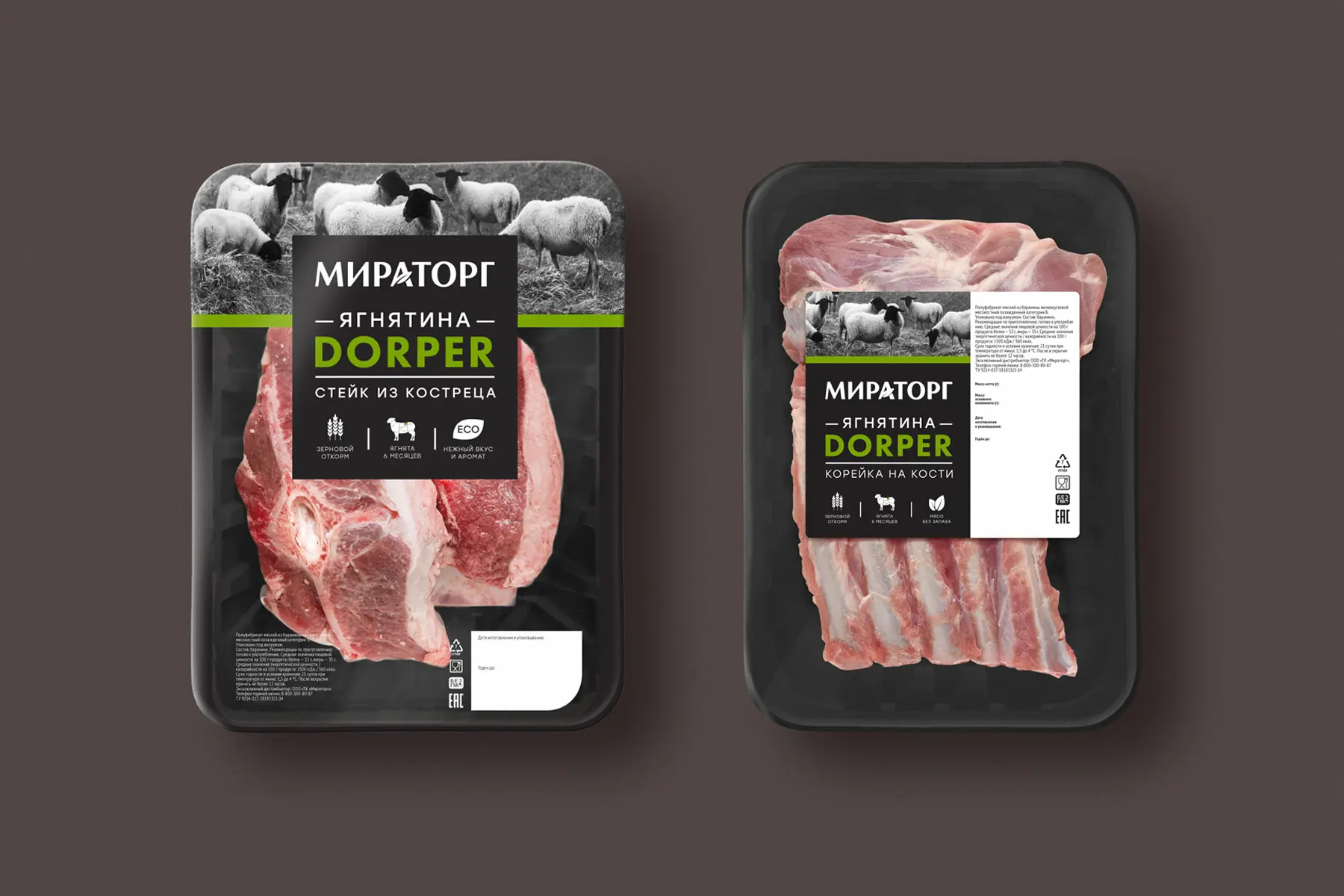
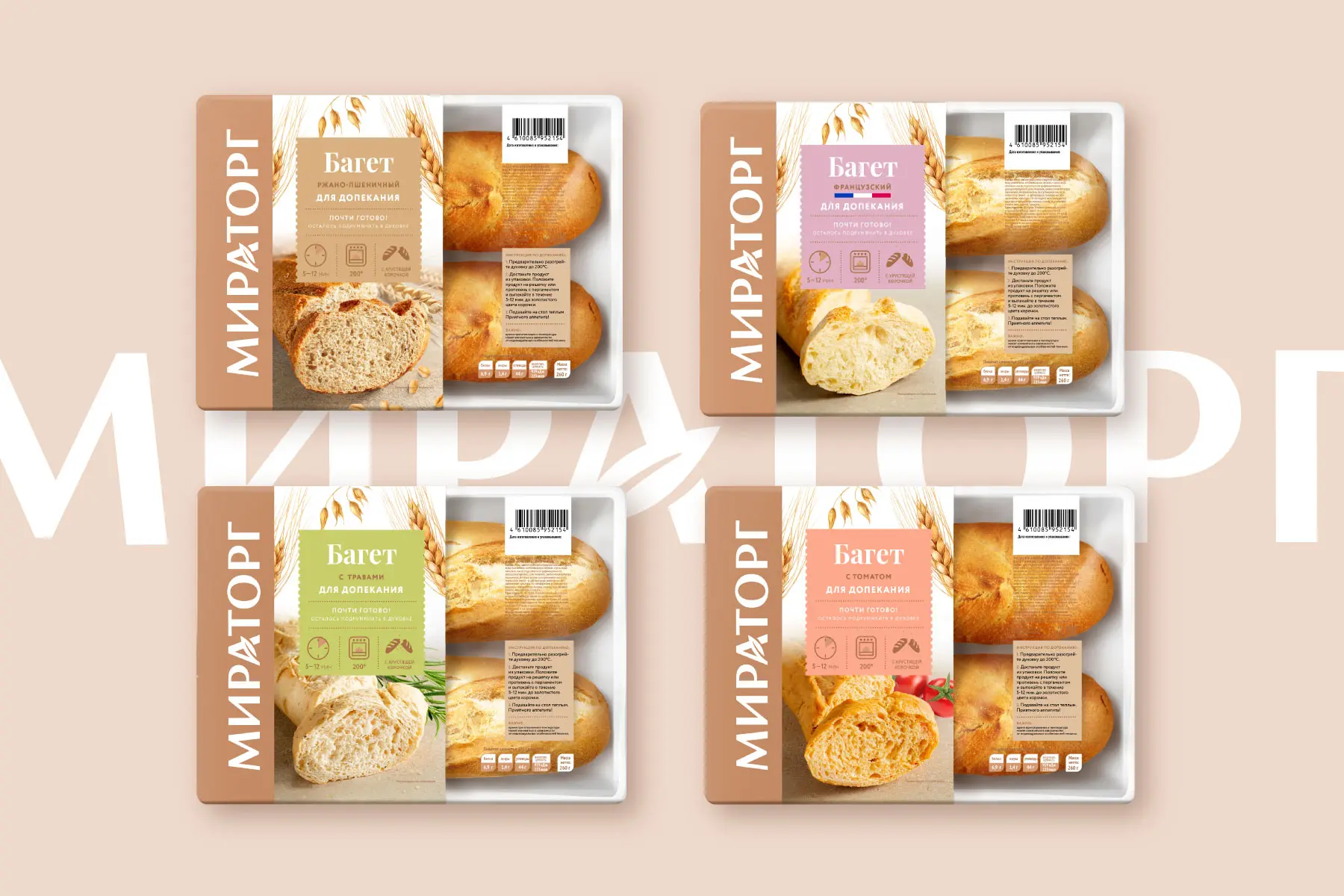
Miratorg — Brand Positioning, Logo Design, Brand Identity Design, and Brand Guidelines. The largest Russian agro-industrial holding, the absolute leader in the production of pork and beef in Russia Miratorg has updated the visual image of its corporate brand and retail brands to unify the brand graphically and stylistically.

Vitamir — Brand Positioning, Logo Design, Packaging Design, Brand Identity Design, Brand Guidelines, Mascot Design, and Website Design. BRANDEXPERT agency made successful rebranding of pharmaceutical company VITAMIR. A brand platform, logo, corporate identity, packaging design and brand book were developed.

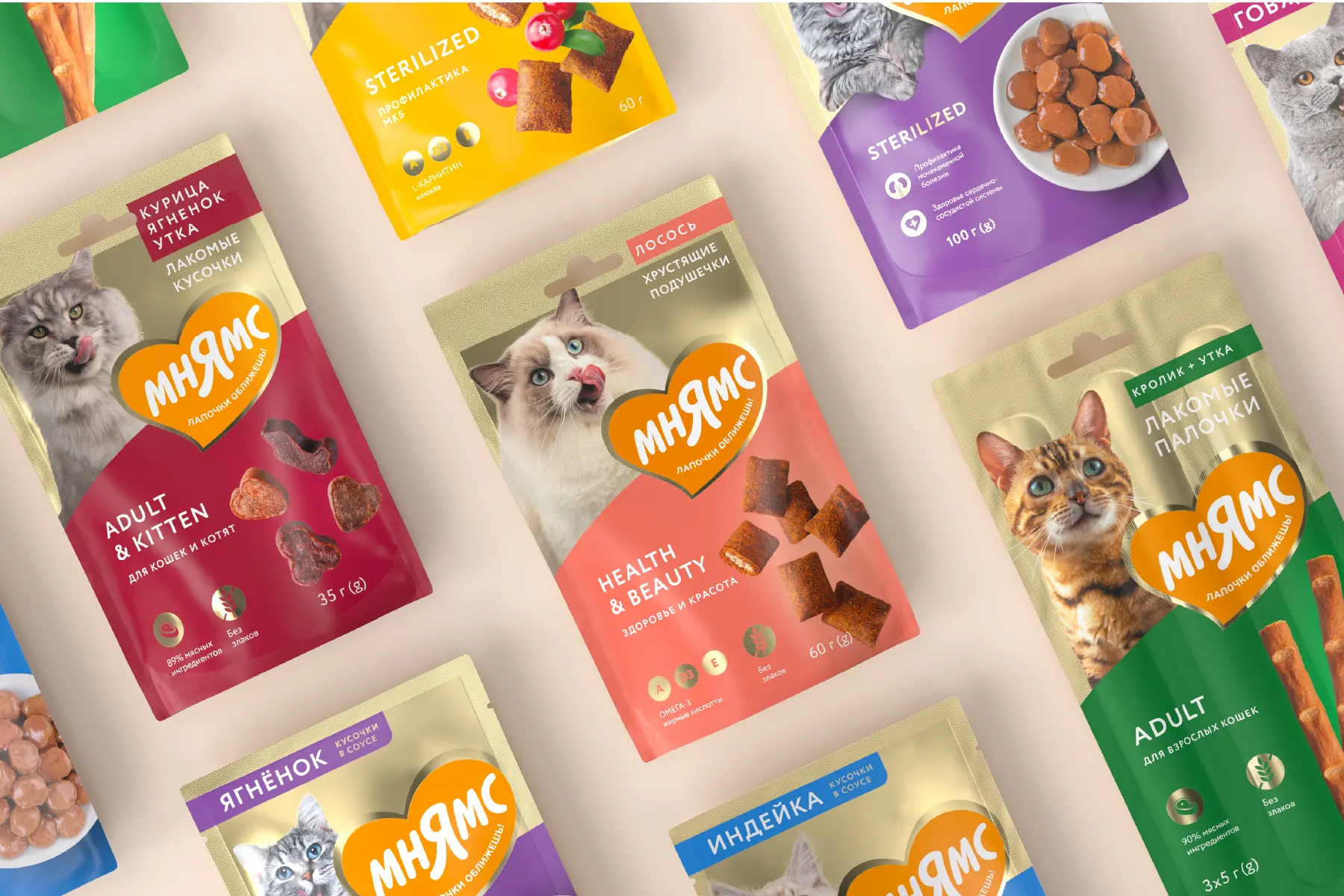
AlphaPet — Brand Positioning, Brand Identity Design, Brand Guidelines, and Advertising Communications. AlphaPet offers super-premium cat and dog food. BRANDEXPERT Freedom Island developed brand guidelines and designed advertising materials and a product catalog for AlphaPet.

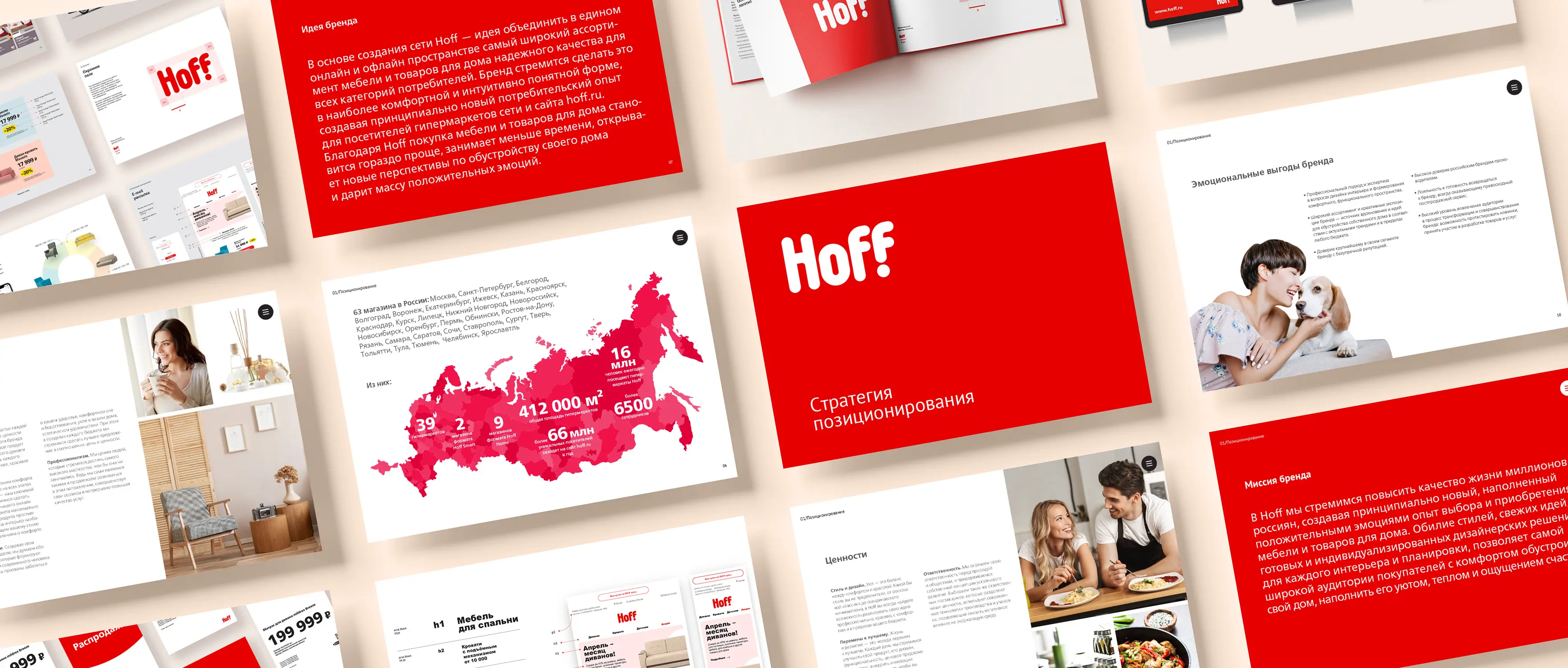
Hoff — Brand Identity Design, Brand Guidelines, Retail Branding, and Interior Design. BRANDEXPERT Freedom Island developed a brand positioning strategy, a new retail strategy, brand identity design, and advertising design.
FOXGEAR — Brand Positioning, Naming, Logo Design, Packaging Design, and Brand Guidelines. Visual brand strategy for FOXGEAR, a leading lubricants manufacturer. Logo and brand identity design as part of the company’s new visual language. Packaging design for the brand’s product ranges.

Kolomensky — Brand Positioning, Logo Design, Brand Identity Design, and Brand Guidelines. Visual brand strategy for Kolomensky, a leading manufacturer of bread and baked goods. Logo design, brand identity design, and marketing communications for the brand. Packaging and label design for the Danilovsky product range.

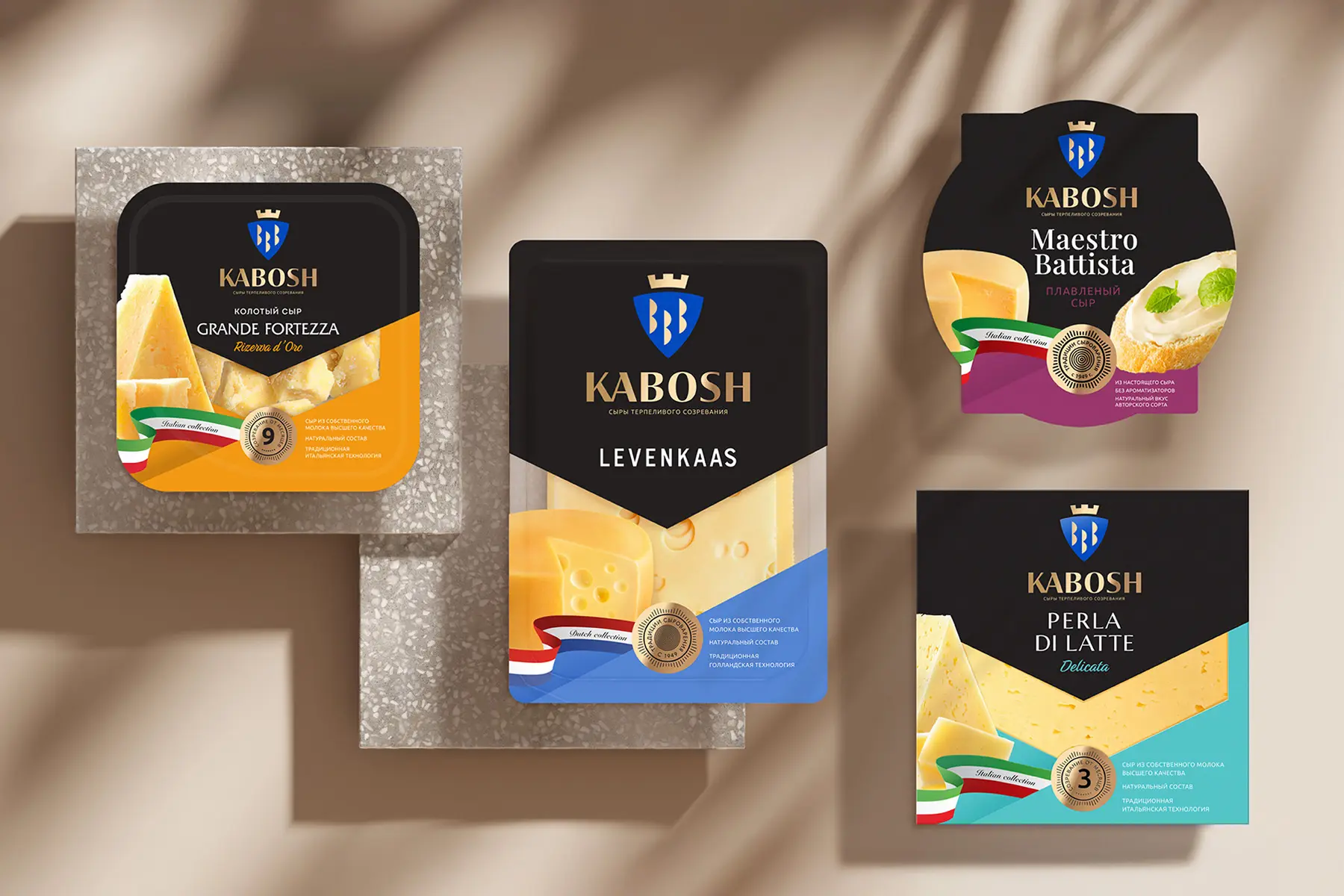
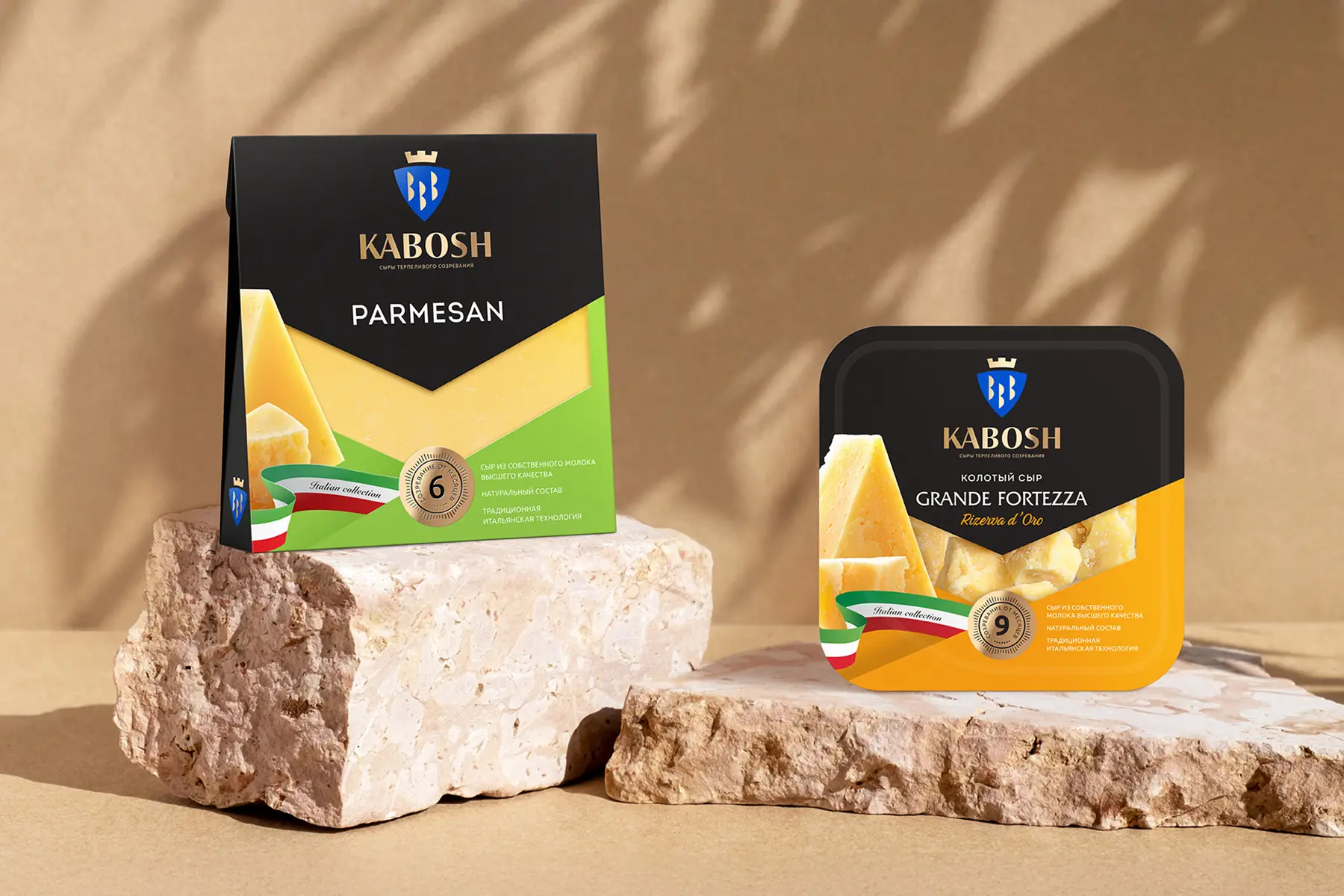
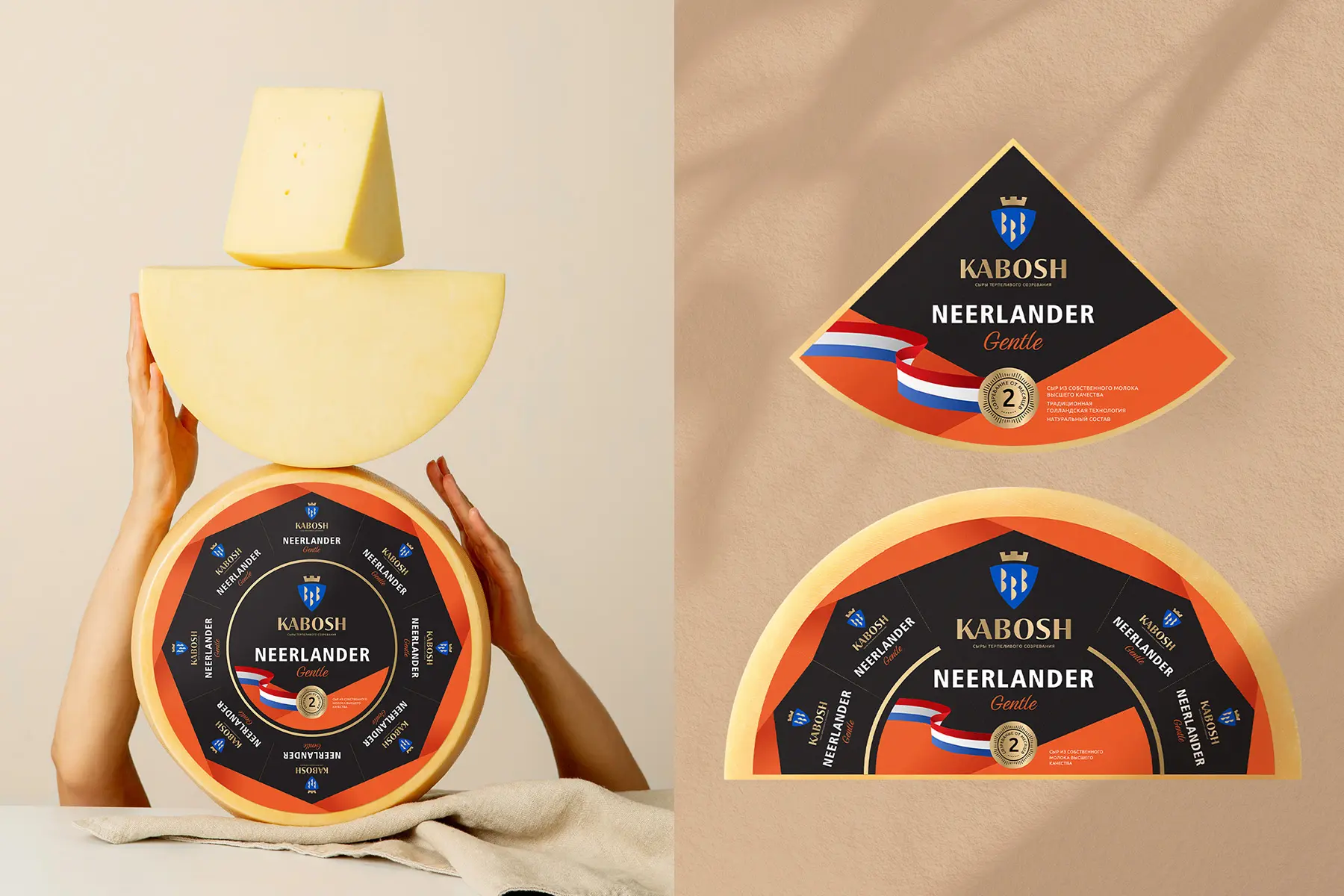
Kabosh — Rebranding, Logo Design, Packaging and Label Design, Brand Guidelines, Photography, and Website Design. BRANDEXPERT agency made a comprehensive rebranding for cheese producer KABOSH. A brand platform, logo, corporate identity, advertising design, product packaging and brandbook were developed.

Oceanis — Brand Positioning, Logo Design, Brand Identity Design, Brand Guidelines, Interior Design, and Advertising Communications. BRANDEXPERT agency made a comprehensive work to create a unique OCEANIS retail brand
ATEMI — positioning, logo development, corporate identity, packaging design. BRANDEXPERT “Ostrov Svobody” carried out the rebrand of ATEMI: the brand strategy was updated, and a new logo and visual identity were developed, along with packaging and label design, a brand book, print and advertising design, and professional photography for the brand’s communications.

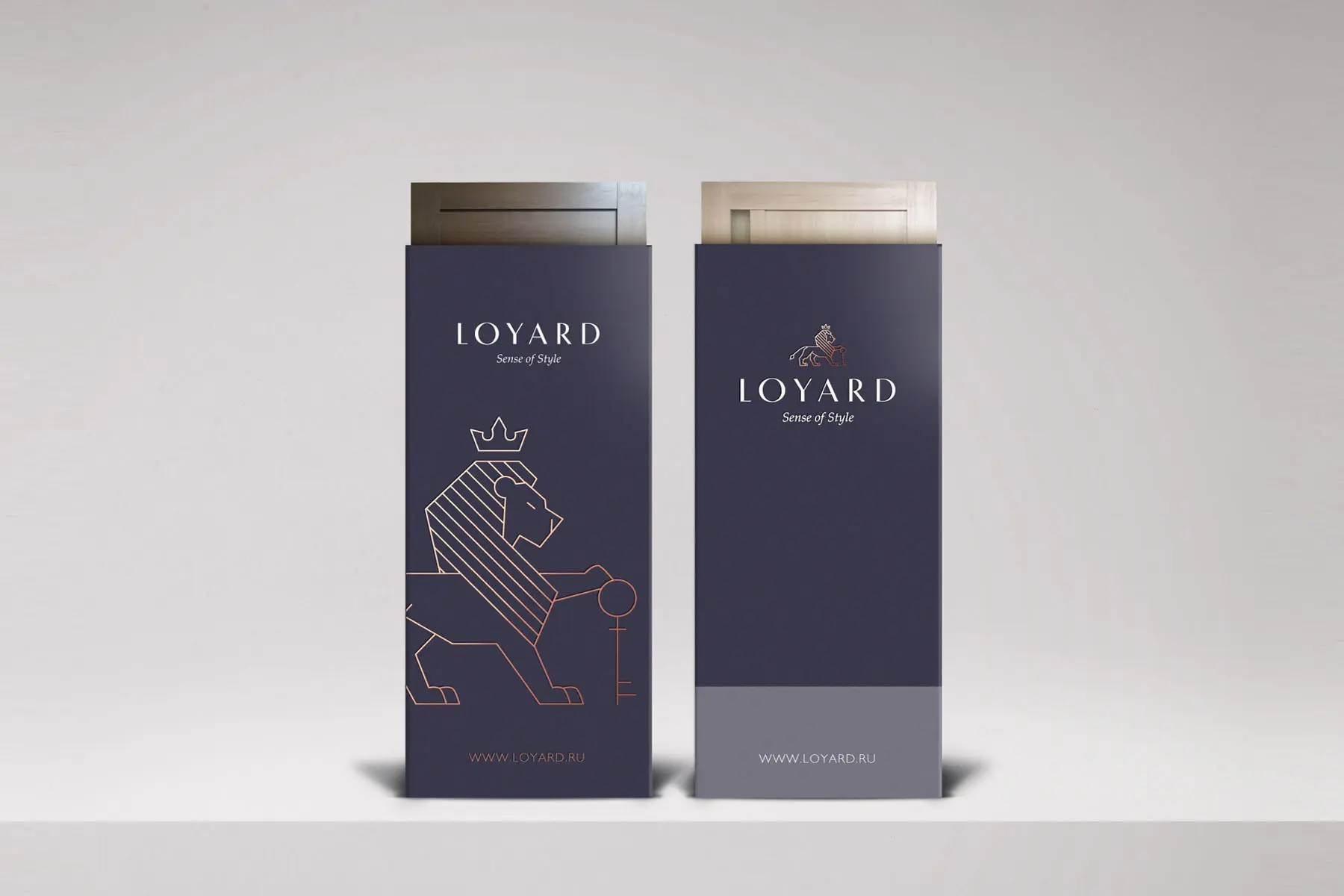
PROFIL DOORS. The BRANDEXPERT agency conducted a comprehensive rebranding for the PROFIL DOORS company. We developed the brand platform, logo, corporate style, advertising design, retail brand and brand book.
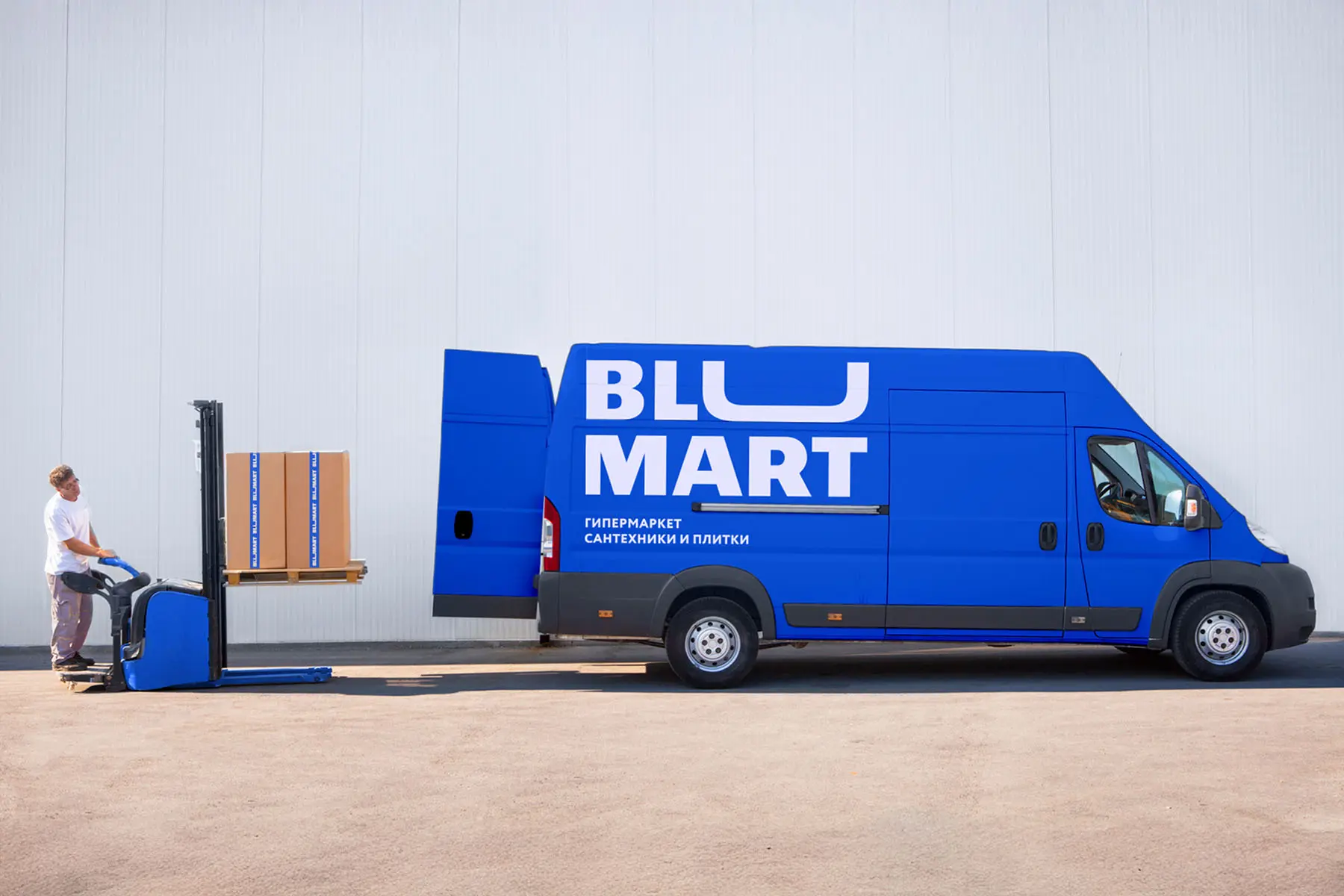
BLUMART. Creating the brand for the first and largest hypermarket of plumbing and tiles in Russia, BLUMART. The project includes: platform for positioning and naming, creating a logo and identity, designing the interior, and developing a brand book.
Zoonik. Brand marketing strategy for ZOONIK, a top pet products brand. Design of a logo and visual identity as part of the brand’s updated identity system. Development of a packaging design concept for the brand’s product lines.

???. Rebranding of "Sochinsky Meatworks," the largest producer of delicatessen meats and sausages in southern Russia. Developed packaging and label design for products. Created brand guidelines and positioning strategy outlined in a brand book.

???. The BRANDEXPERT agency conducted the rebranding of the company DECORATION, including the brand platform, logo and corporate style. As part of creating the retail brand, interior designs, positioning strategy and advertising design were developed.

Veda Pharmacy. Creating a brand and developing a brand book for the veterinary company VEDA, a leading Russian developer in the field of veterinary phytotherapy. Establishing a corporate style and logo for the brand, the first choice in animal care and treatment.

???.

IXcellerate. BRANDEXPERT has updated the corporate identity of the IXcellerate brand, one of the leading data centers in Russia. The new corporate identity maintains continuity with the previous design

???. Grand Plier is a new Russian natural cosmetics brand. Brandexpert developed the new brand from scratch: brand name, packaging design, product catalog, website, and professional photos

MOON. MOON is the largest furniture factory in Europe. BRANDEXPERT agency made a repositioning, created logo, brandbook, packaging design and retail branding of furniture stores.

Moscow Bicycle Festival. BrandExpert created a colourful, flexible, and eloquent brand identity and ads for the Moscow cycling festival

ROST. ROST holding is one of the largest players in the Russian food market. Brandexpert completely updated ROST's corporate brand identity, logo design, brand guidelines, and packaging design solutions.

Darov. Darov is a new retail chain with a strong accent on delicious prepared foods. Brandexpert developed the new brand from scratch: brand name, brand identity, logo, brand guidelines, packaging design, and interior design solutions

OKRAINA. Okraina holding’s matrix includes only natural meat products. The branding agency BRANDEXPERT re-branded the whole holding: developed the corporate brand identity, logo, brand guidelines, website, and also created packaging design.

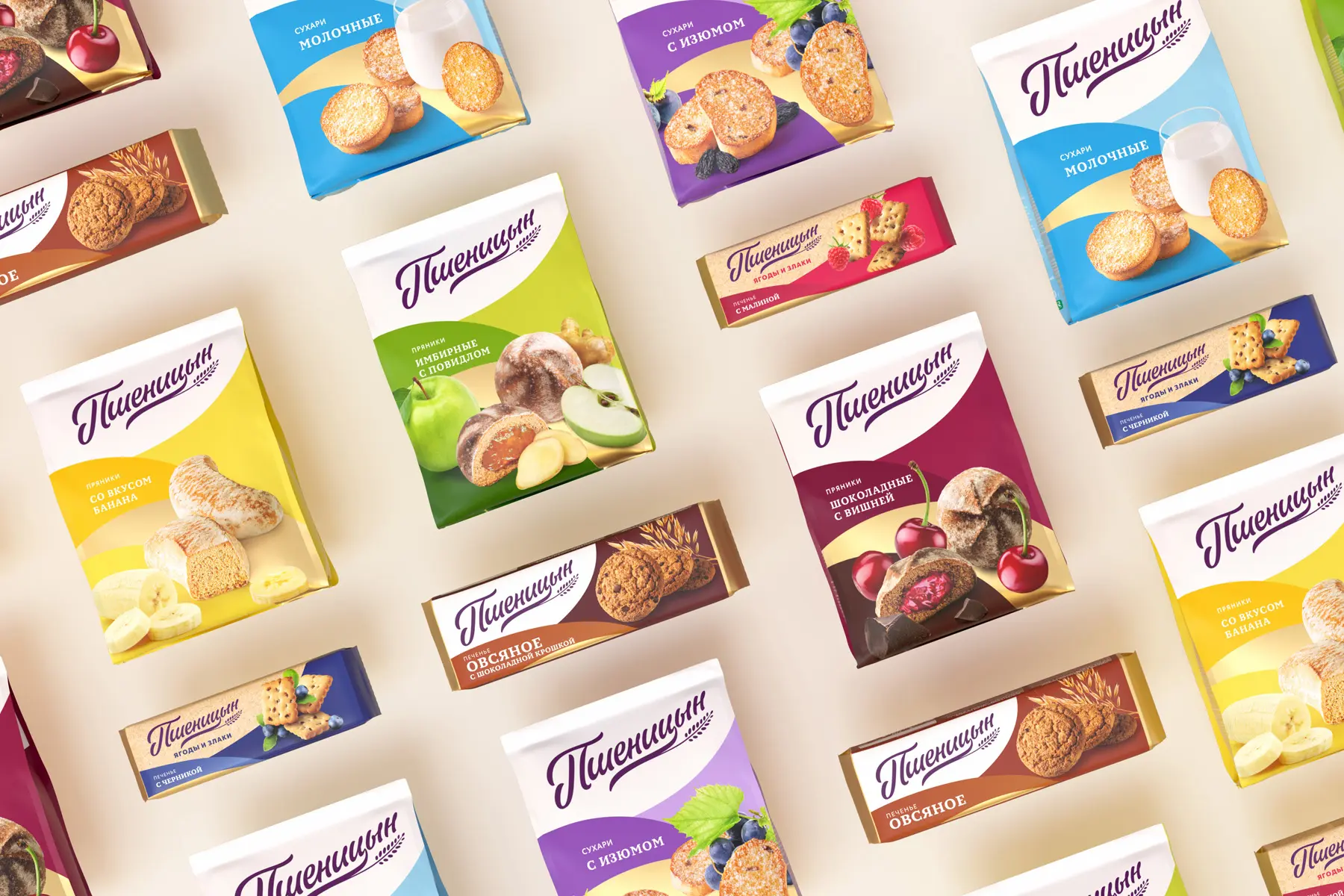
Ageevskiy. Creating the brands "Pshenitsyn" and "Papa Roma" for the confectionery factory "Ageevsky". Logos for the brands, packaging design and product labels were developed. The corporate logo and brand identity of the company "Ageevsky" have been updated.

Konti. Konti confectionery corporate brand restyling performed by Brandexpert: logo and corporate identity design, retail store interior design, brand guidelines, packaging and label design, multiple sub-brands created from scratch.

What is brand positioning
Making a product stand out so that it finds its way to the target audience is the primary goal of any brand strategy. It is impossible to achieve this without proper brand positioning. Thanks to positioning, the brand will become noticeable among competitors and will not remain unclaimed.
Entering a market is challenging even with three or four strong competitors, and for familiar everyday products such as cheese, face cream, or bedding, their number is measured in dozens and hundreds. However, even a startup developing a unique product will go unnoticed without a clear brand positioning strategy. Only through branding will you differentiate yourself from competitors and find a distinctive place both in the market and in your consumers’ minds.




Brand positioning: key components
A positioning strategy is built on a set of elements that define the brand’s meaning, visuality, and communication. Depending on the business and goals, these components may vary, but most often the basis includes:
brand essence
brand idea and promise
archetype
reason to believe
values
mission and vision
communication platform and brand attributes
positioning statement
All of these elements are usually assembled into a brand platform (or a brand strategy, if the document is expanded).

Brand pyramid
There are several systems that can be used to structure a brand platform and present it in a condensed form. A universal way to do this is the brand pyramid.
At the base of the pyramid lies the brand’s marketing strategy: the product or service it promotes, its target audience, its projected position in the market, and its relationship with sub-brands, if any. This is the foundation of the brand positioning strategy — the starting point for building the image of any company.
In the middle of the pyramid are blocks that describe more subjective characteristics: how the company is seen by its employees, its customers, and its competitors, as well as the brand’s communication strategy.
At the top are the essence and the idea: a succinctly expressed brand image that appeals more to the emotional than to the rational side. These are the most concentrated expression of the brand platform.
There is no single standard format for a brand pyramid; the presence and number of blocks are determined by the specifics of each particular case and by the branding objectives of each individual company.



Brand essence
Brand essence is a succinctly formulated expression of what makes a brand distinctive. One sentence—or even a single word—is enough to capture the brand strategy and its foundation. It reflects the brand’s identity, values, and emotional characteristics.
Examples of formulations used by leading global brands:
McDonalds — “Consistency”
BMW — “Driving pleasure”
Yandex — “Making life simpler and more interesting through technology”
Harley-Davidson — “Freedom, independence, and adventure”
Coca-Cola — “Happiness”
VkusVill — “Here, healthy is tasty”
Brand essence must be relevant: it should give a clear understanding of how a product or service solves the customer’s problem and fits into the company’s brand strategy, without getting distracted by secondary characteristics.
It must also be unique. Simply copying competitors won’t work—brand essence should set the brand apart from similar products, highlighting its rational advantages and emotional tone. The strategies of new brands are often built around emphasizing their unique essence compared to competitors.
In addition, brand essence must be authentic: it should reflect the company’s real characteristics and values, rather than being a set of abstract statements used only in branding. It must also be long-term. Brand essence does not change over time; it can be expanded, but its core—the key principles on which the brand platform is built—remains unchanged.





Brand idea and brand promise
Brand idea is a description that succinctly and vividly communicates to the customer what benefits they can gain from your products or services and how those benefits are connected to the brand’s image.
The idea answers the question “What does the brand promise its customer?”, appealing not only to rational benefits but also to emotional associations. The entire further strategy of brand development is built on it.
BMW. BMW’s goal is to deliver the ultimate driving experience. For more than 100 years, the company has brought innovations in styling and engineering solutions. The group’s brand strategy is to create cars that are not just a means of transportation, but an extension of the driver. BMW combines luxury, top-tier performance characteristics, and revolutionary design so that the driver feels truly comfortable behind the wheel.
McDonalds. McDonalds’ brand strategy is to be the best fast-food restaurant, offering consistent quality standards and friendly service in thousands of locations worldwide. From classic hamburgers and French fries to seasonal and regional novelties — everyone can find something they like on its menu, and every visit to McDonalds will be pleasant and convenient.
Yandex. Yandex is a guide to innovation that makes everyday life easier. Its brand strategy is built on creating the image of a reliable assistant that helps cover all the key needs in the digital world—from searching for information to organizing leisure.
Google. Google gives everyone access to a boundless source of knowledge. Its goal is to organize the vast sea of information, make it useful, and make it universally accessible. Google is something more than just a search engine; it is a catalyst for learning, collaboration, and innovation. The company’s brand strategy is built on the idea of striving to improve users’ lives, enabling them to explore, learn, communicate, and create in a digital space filled with limitless opportunities.
Amazon. Amazon is a way to make everyday life more convenient. The brand’s development strategy is built on the idea of a store where you can not only find anything, but also receive it with ease. Amazon is not just a platform; it is a reliable guide in the world of online shopping.
Aeroflot. Aeroflot is the national carrier and the largest airline in Russia. For more than 85 years, it has helped its passengers fulfill their life plans and dreams—work efficiently, relax enjoyably, meet family and loved ones, and discover new countries and cities. The idea underlying the brand platform is to do everything so that passengers feel safe, confident, and comfortable in the sky.
A brand idea must be clear. It does not require precise descriptions of consumer properties, but the buyer should easily grasp what exactly is being promised and what lies at the core of the brand platform.
It must also be customer-centric. The idea indirectly communicates about the company and its values, but its foundation is a description of how the product will be useful to the customer on emotional and rational levels.
A successful brand idea will always feel original. It is important not only to explain what you offer, but also—explicitly or implicitly—to differentiate from competitors (for example, by highlighting in the brand promotion strategy the quality in which you are the leader).
The idea must also be credible. For the brand’s marketing strategy to be effective, the customer must believe that you can deliver on the promise. This can be achieved by referring to objective facts—many years of experience, market coverage, and so on.
Last, but one of the key properties: the idea must be emotionally charged. The goal of the idea is not only to explain how a product or service will solve the customer’s problem, but also to convey the emotions of interacting with the brand. The most successful brand promotion strategies always imply an appeal not only to the rational, but also to the emotional component.








Brand archetype
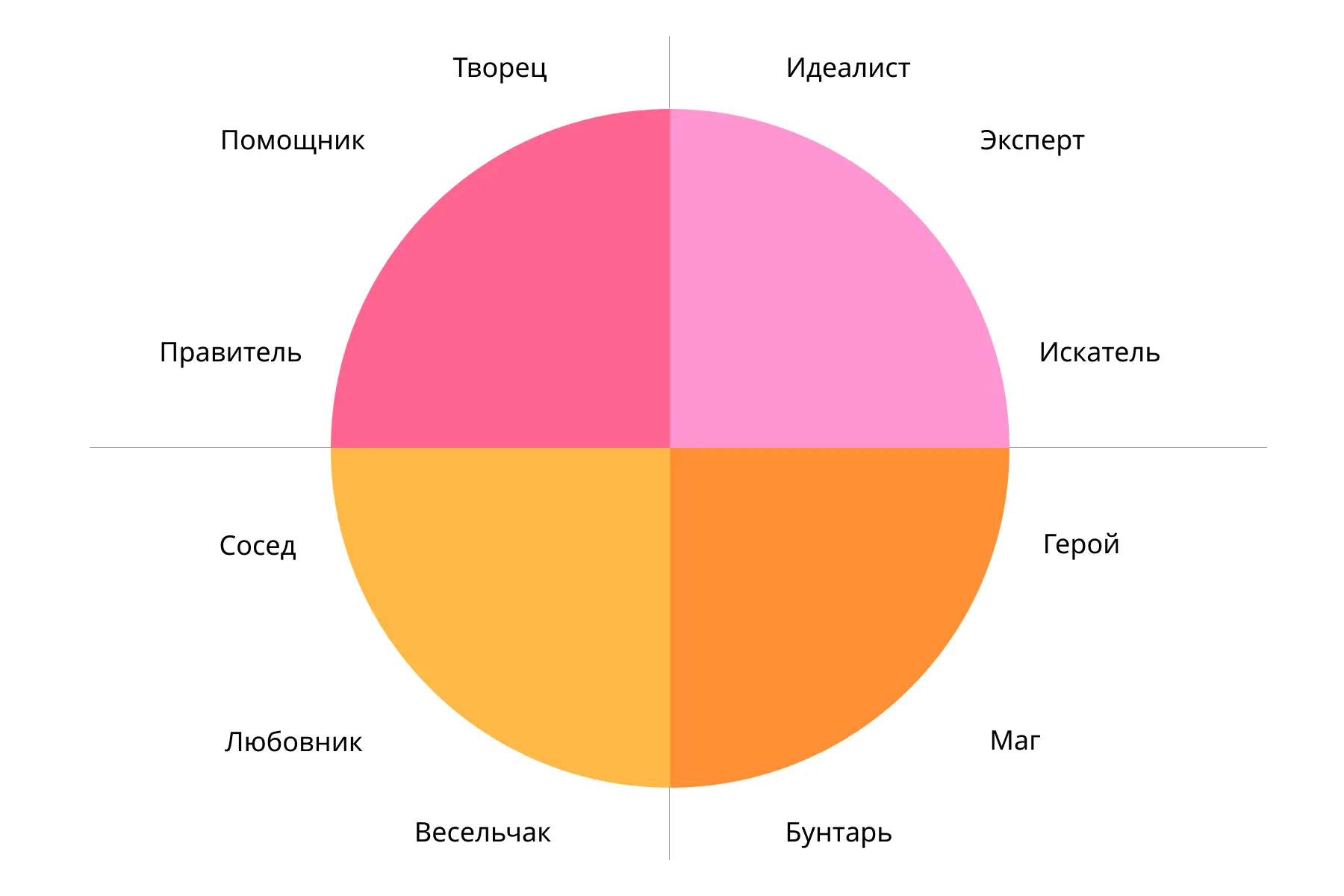
Brand archetype is a set of universal images and associations on which a brand strategy is built. Some brands rely on archetypes more explicitly, others less so, but at the core of every strategy lies a certain archetypal set of ideas.
The theory of archetypes was first formulated in the early 20th century by Carl Jung. According to it, archetypes are fundamental symbols that exist in the human mind independently of personal experience.
In the early 21st century, archetype theory was applied in branding: psychologist Carol Pearson and marketer Margaret Mark identified 12 key images used in advertising to appeal to the collective unconscious of the mass consumer, along with the situations and behavioral patterns associated with them. In terms of building a brand strategy, the archetype answers the question: “What kind of character does the brand have?”
The following associations are typical for these archetypes:
The Rebel — breaking usual but ineffective patterns. This brand strategy is used to promote products that help stand out from the crowd. These can be clothing brands (Diesel, Converse, Monochrome) or provocative motorcycles and cars (Harley-Davidson, Ford Mustang), but the Rebel archetype is also used in the branding of companies that emphasize their differentiation from competitors and innovation in their approach to doing business (PayPal, Virgin, Tinkoff).
The Magician — subtle yet radical (“magical”) changes in everyday life. Whether it is instant photography (Polaroid), the ability to pay by card anywhere (Mastercard), a trip to a wonder park (Disney), or an ecosystem of services for big-city residents (Yandex) — their brand strategy uses the Magician archetype.
The Hero — overcoming oneself, striving to become the best. Sports brands (Nike, Adidas, Sportmaster), products and services positioned as best-in-class (FedEx, Duracell), banks, insurance, and consulting firms promising success in competitive struggle (PwC, J.P. Morgan Securities, Deutsche Bank) — the brand platform of all these companies is built on the Hero archetype.
The Explorer — travel as a path to self-discovery. The Explorer embodies the desire to open new horizons and, through that, live a fuller life. Examples of brand platforms built on this archetype include manufacturers of warm clothing (The North Face, Timberland), SUVs (Jeep, Land Rover, Subaru), as well as all brands associated with travel and new discoveries (National Geographic, SpaceX, NASA).
The Sage — the search for truth. The Sage archetype is traditionally used in the brand promotion strategy of news platforms (BBC, CNN, RBC), as well as search engines (Google, Wikipedia, TED), manufacturers of computing electronics (Intel, IBM), and businesses related to consulting in one form or another (hh.ru, Kaspersky Lab).
The Innocent — simplicity and optimism. The Innocent archetype embodies the image of a child or a naïve person who believes in miracles and a bright future. Dove’s brand positioning is built on it; similar ideas are used in the branding of Nestlé and Volkswagen.
The Creator — creating something new and unique. This archetype underpins the brand promotion strategy of brands associated with visual arts (Adobe), creativity (Apple, YouTube, Lego), and innovative solutions (Tesla).
The Ruler — power and order. This archetype is typically used in the brand strategy of companies selling premium clothing and accessories (Hugo Boss, Louis Vuitton, Rolex, Hublot), luxury cars (Rolls-Royce, Bentley), and in the brand platforms of companies aiming to become monopolists in their markets (Microsoft, American Express, Gazprom).
The Caregiver — care. The Caregiver archetype is characteristic of everyday goods (Campbell’s, P&G, Splat, BioMio), is often linked to caring for children (Huggies, Johnson & Johnson, FrutoNyanya), or is associated with an elevated level of safety (Volvo).
The Lover — attractiveness and sensuality. This archetype suits the branding of fashion and perfumes (Victoria’s Secret, Chanel, Dior, L’Oréal, Yves Saint Laurent), sports cars (Alfa Romeo, Jaguar), and premium-priced confectionery (Häagen-Dazs, Godiva, Lindt).
The Jester — humor and a light attitude toward oneself and the world. As a rule, the brand strategy of snack and soft drink producers is built on it (Pepsi, M&M’s, Skittles), as well as men’s grooming products (Old Spice).
The Regular Guy — joy in life’s simple things. This archetype is used in communication strategies of brands associated with everyday life, simplicity, and reliability. Its bright representatives include IKEA, eBay, Wal-Mart, GAP, Levi’s, Avito, Pyaterochka.
A successful brand strategy typically combines elements of several archetypes: McDonalds — the Innocent and the Regular Guy, Apple — the Creator, the Magician, and the Rebel, GoPro — the Hero and the Explorer, and so on.
At the same time, one should not assume that archetypes were not used in advertising before; rather, this is a kind of formalization of intuitive, widely understood clichés that lie at the core of a brand platform.
Archetype should also not be confused with a mascot: an archetype is a universal symbol the brand appeals to, which may not be expressed in advertising as a specific character, whereas a mascot is a character spicial developed for the brand.




Reason to Believe
Reason to Believe (RTB) is a set of arguments that convinces the consumer to believe the brand’s promise. It is not enough to claim that a product is exceptional—you need to back such claims with evidence. The arguments used in branding should be logical, but they do not have to be 100% measurable.
If you have an advantage that can be clearly verified — use it. An example from Amazon’s brand strategy is positioning itself as the platform with the widest selection of goods in the world. Convenience of ordering and delivery also belong to the list of the brand’s key advantages, but when it comes to assortment breadth, Amazon’s leadership is indisputable—it is intuitive and at the same time verifiable.
A less obvious, but still measurable argument is a reference to the brand’s age. Ford has been producing cars for more than 120 years, which makes it one of the pioneers of the automotive industry. At the same time, over its century-long history the brand has not been accompanied only by successes, and its current position can hardly be called leading compared to the beginning of the 20th century. Nevertheless, a reference to its age and the experience and high standards of production processes associated with it is one of the key elements of Ford’s brand platform.
Collaboration with leading players in the industry can also serve as a quite tangible proof of a brand’s high quality. An example from Monochrome’s brand strategy is positioning itself as the only Russian clothing brand that has released collaborative collections with such labels as Pantone, Reebok, Casio G-Shock, and Smashbox.
Reasons to believe can also be more intuitive. For example, GoPro’s slogan —“Be a Hero”— symbolizes the drive to seek adventure that the brand brings into customers’ lives. Even without specific statistics and examples, owning such a camera, GoPro’s brand strategy is built on associations with extreme sports, which transfers a part of this extraordinary experience to the buyer’s self-perception.
A strong outcome in a brand positioning strategy is a situation where a characteristic is endowed with both emotional and rational value at the same time. For example, the bright look of Patagonia trekking backpacks makes them fashionable and more appealing to a young, active audience, but it also has practical value in wilderness conditions.
Regardless of how concrete or abstract a brand’s RTBs are, they must be:
Logical. Whether it is a reference to measurable data or simply a set of statements — in a brand’s marketing strategy, the reason to believe must be supported by arguments; it cannot be a mere declaration. This is especially important when developing strategies for new brands that have not yet built a stable reputation with the audience.
Connected to the brand’s identity and positioning. Do not focus on qualities that add no extra value to the message; use only those characteristics and features that work to strengthen the brand strategy and the product’s image.



Brand Values
Brand values are a set of qualities that receive special attention when shaping the image of individual products and on which the brand platform as a whole is built. One could say these are key reference points that are emphasized in all marketing and business activities — a kind of rule set that helps both customers and employees better understand the essence of the brand when planning the brand’s marketing strategy.
Values are divided into several types:
Functional. Key practical characteristics that matter to buyers: quality, price, convenience, etc.
Emotional. Values tied to sensory and aesthetic associations embedded in the brand platform and communicated to the buyer.
Motivational. Ideas related to personal and professional development—implementation of new technologies, encouragement of a healthy lifestyle, etc. They are used in the brand promotion strategy both among customers and among current and potential employees of the company.
Social. Principles that communicate the company’s ethical stance—responsible manufacturing, charity, environmental protection, etc.
Corporate. Ideas that define the brand’s positioning in relation to employees and external partners. They concern both current business processes and long-term plans.
A clearly formulated set of values lies at the foundation of any successful brand platform. For IKEA these would be “thrift,” “simplicity,” “functionality,” “care for people and the planet”; for Tochka Bank — “individual approach,” “lack of bureaucracy,” “ambition and proactiveness”; for the Shokoladnitsa brand — “quality,” “everyday pleasures,” and “urban spirit.”
From the outside, a brand’s list of values can sound like a fairly random set of words used only within branding and not connected to the company’s real work. But when you relate them to how the company behaves in the market and communicates with customers, what characteristics its products have, how business processes are organized, and how the brand’s communication strategy is implemented, it becomes obvious that the brand’s entire activity is built (or at least aims to be built) around these key points.


Brand Vision and Mission
Brand vision and mission are related concepts that reflect the brand’s goals and aspirations and explain what drives it. Both speak about the company’s motives, and both lie at the foundation of its brand strategy. However, there are still differences.
Brand mission is an idea-driven message about what matters to the company beyond profit.
Disney — “Make people happy”
Google — “Organize the world’s information and make it universally accessible and useful”
VkusVill — “Make healthy food for a healthy diet accessible to everyone”
Airbnb — “Create a world where anyone can belong anywhere”
Spotify — “Enable millions of artists to share their music and billions of fans to enjoy it”
HH.ru — “Create advanced technologies on all available platforms so that employers can quickly find the right employee, and job seekers can find a good job”
Brand vision (Brand Vision) answers the question of what the company’s global goal is and what achieving it will look like. In some cases, a brand platform may use another synonymous concept: “the brand’s goal.”
Disney — “Become the best in producing entertainment content, creating pop-culture images recognizable to everyone”
Google — “Provide access to any information in the world in one click”
Detsky Mir — become the national benchmark for a store with the broadest assortment of quality goods for children and teenagers
Tesla — “Create the leading automotive company of the 21st century by leading the transition to electric vehicles”
Sber — “Be a convenient ecosystem of services that meets the needs of the modern city resident. Every day, always nearby”
Lenta — “Become the champion of Russian retail”







Brand Communication Platform
A brand communication platform is a set of principles and rules according to which a company communicates with its audience — principles on which its brand strategy and style of interaction with the consumer are based.
A key element is tone of voice. It determines what vocabulary and what manner of communication are preferable for the company. It is the guideline the marketing department relies on when preparing any advertising activity and building the brand’s communication strategy as a whole.
Humor — sometimes even a bit rough — is part of Old Spice’s image, but it is certainly not appropriate in the branding of, for example, Mercedes-Benz. At the same time, the tone can change over time — both globally for the brand and within a single campaign.
The example of Old Spice’s brand positioning shows that a company’s image can seriously transform over the years. The rebellious image familiar to us formed relatively recently — in the mid-2000s; before that, the brand platform was far more conservative.
One brand strategy may involve using several tones of voice at once — depending on the situation and the goals of communication. For instance, Ozon’s brand communication strategy states that humor and emotional vocabulary may be used when there is good news for the customer — free delivery, bonus points being credited, and so on. For neutral and, even more so, negative occasions, such a tone is strictly prohibited.
Another element of the communication platform is the brand’s key message. This is the characteristic emphasized in every message — the cornerstone of the brand platform. For example, for Coca-Cola it is positive emotions; for Nike, overcoming oneself; for Yandex, the ability to find anything.
The platform also includes a communication strategy — communication decisions that support the brand’s image. Amazon, which emphasizes customer centricity and a combination of broad choice and personalized offers, builds its brand marketing strategy through contextual advertising, demonstrating awareness of each individual customer’s tastes. There are other ways of interaction as well: for example, Red Bull’s branding reinforces the company’s adrenaline-driven image through sponsorship of competitions for extreme sports enthusiasts and participation in the life of their community.
An additional element of the platform is territory: places and situations where advertising will be appropriate — and, conversely, where it will not. Partly a sub-point of the communication strategy, defining territory is one of its most important components, because emotions from the surrounding context will influence perception of the message and how the brand’s marketing strategy will work overall. For example, a BMW banner will not work in a fast-food restaurant, just as business-class passengers do not expect to see M&M’s advertising in the cabin.





Brand Attributes
Brand attributes are audiovisual markers that allow customers to instantly recognize a brand among others. Beyond recognition, attributes reinforce the brand’s positioning and the company’s image.
Mandatory attributes include:
Name. Strong naming plays a key role in a brand’s success. For example, the name Google — derived from “googol” (10 to the power of one hundred, 10^100), chosen by the company’s founders as a symbol of the enormous volumes of data accessible through their service — has already become a synonym for searching for information on the Internet. An unsuccessful name, on the other hand, can significantly harm a product. Without well-chosen naming, a brand strategy will not work effectively enough.
Logo. A memorable logo can be an even more important attribute than the name, complementing it or even replacing it. Classic examples are the Nike and Apple logos, instantly recognizable without additional explanation and having become the foundation of their brand strategy. However, in their original form they were far less successful and took on their iconic appearance only after several redesigns.
Brand colors and typefaces. Along with the logo, these are an inseparable part of the brand’s visual aesthetics and receive enormous attention when developing a brand strategy. They directly influence both recognition and the tone of advertising messages. A strong visual identity becomes the “calling card” of the product and the brand’s positioning as a whole, merging with it so closely that moving away from it can provoke a painful reaction from customers and even a radical revision of the brand’s marketing strategy. Classic examples of unsuccessful choices in colors and typefaces are the redesign attempts by Gap and Tropicana: the new, more neutral and faceless combinations that replaced the iconic visual style of these brands were so disliked by audiences that the companies were forced to quickly return to the old design.
In addition to the above, a brand strategy may also have the following additional attributes:
Slogan. A concise, memorable phrase that conveys both a rational and an emotional message can become one of the main components of a product’s success and of the company’s brand strategy as a whole. Unlike a name, which typically consists of adjectives and nouns, a slogan uses verbs that explain how the product works and what changes it can bring into the customer’s life. The lifespan of a successful slogan is 5–7 years, but some remain unchanged for decades and become an integral part of the brand platform: the iconic slogan “Because you’re worth it” was introduced by L’Oréal in 1971, and “Melts in your mouth, not in your hands” by M&M’s — in 1954.
Mascot. Personalization of the brand’s emotional attributes and associations. Not every product needs its own character, but for some companies it becomes an organic part of the image and brand strategy — or even of the name itself, as with Colonel Sanders or Mr. Proper.
Musical theme. Standing out from competitors through a memorable jingle is another way to build a brand development strategy. “Ba da ba ba ba, I’m lovin’ it” from McDonald’s, or the upbeat whistling in Old Spice advertising—these sounds are firmly associated with the brand and work to strengthen its identity.


Brand Positioning
Brand positioning is the development of decisions that define a brand’s position in the market and its place in the customer’s mind. As mentioned earlier, creating brand positioning is a comprehensive task that includes many elements, such as market analysis, development of a visual style, approval of the communication tone, and others.
Outside the professional community, brand positioning is most often understood as a brand positioning statement (Brand Positioning Statement). A positioning statement is a brief message (1–5 sentences) about the brand’s unique offer. It answers the questions: “What is this brand’s unique offer? What place does it occupy in the market? How does it want to look?”
A clear and understandable example of a positioning statement is Facebook:
“Using the Facebook social network, you can stay connected with old friends and find new ones. We offer a unique digital experience that helps improve your social life. You will be part of the communities you like, among the people you want to be with.”
This brand positioning clearly answers what (“improving social life”), for whom (“for those who want communication”), and in what form (“a social network for finding new friends and communicating with old ones”) Facebook offers. It sets the entire further brand development strategy.
The description of the advantage is not limited to general declarations (“unique”). A specific example is given: users are told about automatic recommendations of new groups, contacts, and publications in accordance with their tastes (“you will be part of the communities you like, among the people you want to be with”). This is not presented as a dry description of the social network’s functions—the brand positioning tries to convey the feeling of joy from communication and being among like-minded people.
Another exemplary positioning statement is McDonalds:
“For those who are looking for the best fast-food restaurant, McDonalds offers consistent quality standards and friendly service in thousands of locations worldwide. As a leader in the fast-food industry, McDonalds continually works to improve the quality of service for its visitors.”
Instead of talking about the menu and the taste of the food, as other fast-food chains do, McDonalds’ brand platform puts the customer experience first. The statement emphasizes McDonalds’ strengths as the first-choice fast-food brand. McDonalds’ brand strategy is to ensure that in any country in the world, the customer is always confident about what set of dishes, service, and speed of service they can expect.
An example of a more “vivid” description is value positioning (Value Positioning). Its task is to communicate briefly and vividly what benefit a customer can get from the product (in this it is similar to a value proposition) and how the brand platform is connected to it.
For Apple branding, a value positioning would be: “The best experience. Only on Apple.”
In two short sentences, the main properties of the product — its brand strategy — are conveyed:
The best user experience across all of the brand’s devices and services, unified high standards (“the best experience”)
Innovativeness (“only on Apple”)
A closed ecosystem (“only on Apple”)
Summing up the above, brand positioning is an attempt to describe its target place in the market and in customers’ minds, maintaining a balance between rational and emotional approaches. The main task that brand positioning solves is to capture the brand’s spirit without sacrificing too much of its objective properties.




Rational and Emotional Brand Benefits
A customer’s choice of a brand is driven by the expectation of the objective and symbolic value they will receive. Products compete with each other not only on price and other measurable characteristics, but also on the feeling a purchase gives. Brand positioning should take both types of benefits into account and build the image on their basis.
Rational benefits are verifiable characteristics. They may relate both to the product itself (composition, production technologies, price, etc.) and to the manufacturing company (age, market coverage, and market segment).
Emotional benefits are the sensory experience of purchasing a product/receiving a service. A clear connection can be traced between rational and emotional benefits. If rational benefits answer the question “What does the buyer get?”, emotional benefits answer “What do they feel while getting it?”
Successful branding implies a combination of both types of benefits in communication with consumers.
An example of a brand platform in which rational and emotional benefits are well articulated is Spotify. Verifiable (rational) characteristics include an online collection of 100+ million songs, as well as the most technologically advanced personalized recommendation system among streaming services. Emotional benefits include the joy of discovering new music and the pleasure of returning to old favorites thanks to personalized playlists.
When creating the Natura Siberica brand platform, the main rational benefits were the manufacturer’s patented bases. The company was the first to bring natural and organic cosmetics to the Russian market; this claim became the foundation of the brand’s communication strategy. The objective characteristics of the brand’s products are reinforced by an aesthetic of naturalness that refers to the richness of Siberian nature.
Emotional benefits can also be verified, although this is a more labor-intensive process. They can be assessed with a certain degree of reliability through surveys, interviews, focus groups, and the evaluation of specific metrics. As a rule, such deep research is undertaken when the brand platform is already being transformed into a more complex brand strategy.



Consumer Insight
A consumer insight is the buyer’s motivation to purchase a product. It describes the combination of rational and emotional prerequisites for buying, and the cause-and-effect link between them, the product’s qualities, and the needs it addresses. When developing a brand strategy in a highly competitive market — and especially when creating strategies for new brands — finding consumer insights is essential.
The issue in question will be truly relevant for the target audience if it is:
Recognizable. The need addressed by the product, as well as the consumption situation, are not artificially created — they are instantly recognized by the buyer. For example, Amazon’s platform allows placing orders in one click without a tedious registration process. The updated positioning of the “Pyaterochka” retail chain and its consumer insight is formulated as follows: “A store for everyday purchases should be one where I feel attention and respect, where going there brings me joy and makes my life better.”
Appeals to suppressed emotions. Effective insights are built on internal conflicts — the task is to present a solution to an important but unarticulated (possibly not fully realized) issue, around the resolution of which the brand strategy is built. A classic case is Dove’s Real Beauty campaign. The brand drew attention to unrealistic appearance standards promoted by cosmetic campaigns. Instead, it emphasized the natural beauty of its customers in its branding.
Presents a new solution. As a rule, the buyer already knows all existing solutions to their need, and for some reason they do not suit them. Brand positioning should offer a new, non-standard way out. For instance, instead of cosmetic improvements to familiar vehicle components, Tesla offers a radically new experience — a ride on autopilot.
When developing a brand platform and working with consumer expectations, it is assumed that the company analyzes the customer’s objective needs, measured by product metrics — number of clicks, search queries, and so on. At the same time, when creating a brand platform, it is necessary to consider the emotional component as well, in order to find a genuine response in the audience—relying on nostalgia or on some unfulfilled desire.
To find such reference points, statistical analysis is not enough — deep understanding of the buyer’s motivation is required. Creating a brand strategy may involve direct communication with the target audience — through surveys, focus groups, in social networks, and so on. Almost always this is done anonymously so that a person feels comfortable talking about their concerns and their attitude toward the brand.



Consumption Occasion
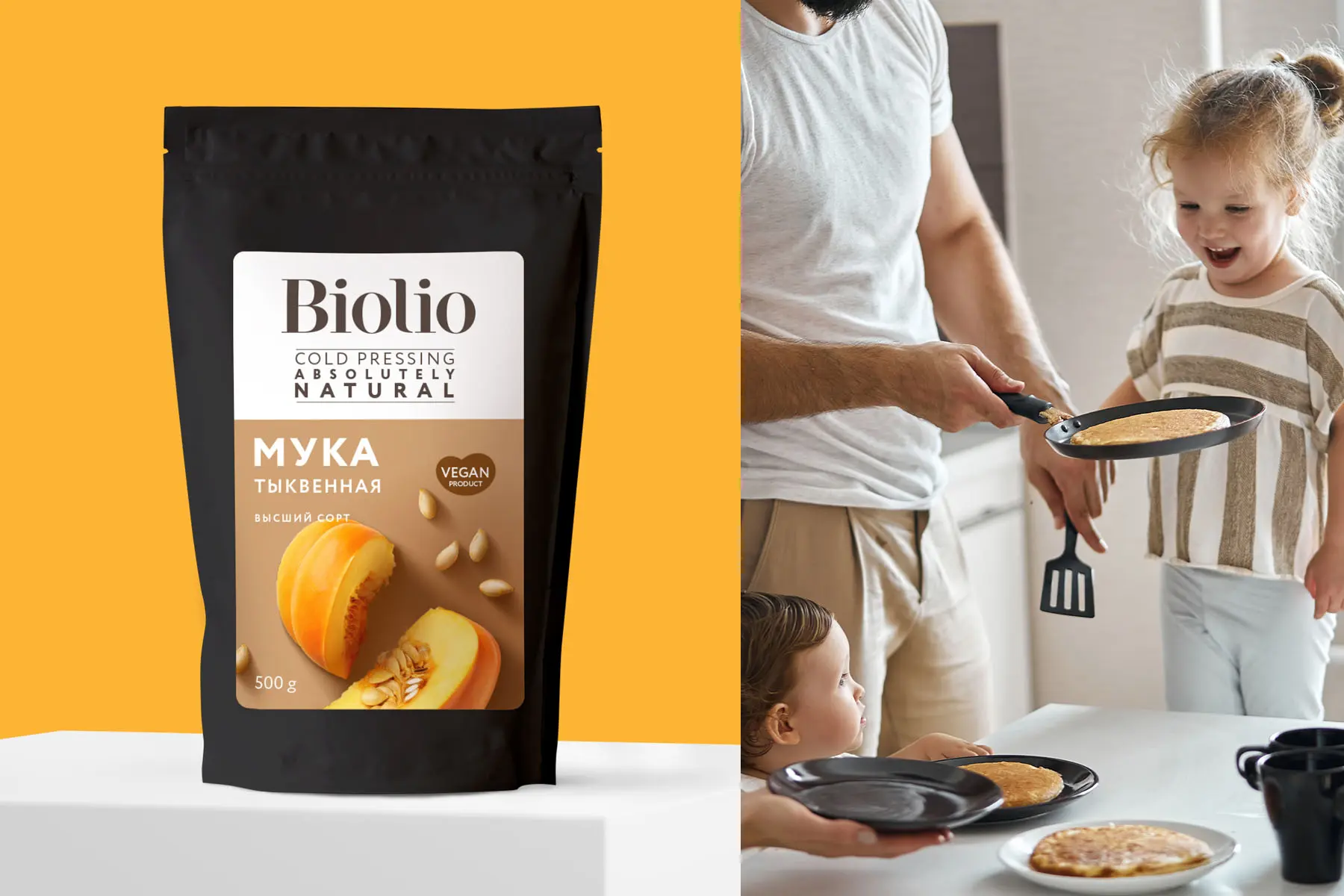
A consumption occasion describes the typical circumstances in which a customer will use a product or service. You identify 3–4 common needs that lead a customer to choose the brand. For example, a vase may be purchased to decorate an apartment, as a gift, for a collection, and so on.
Analyzing consumption occasions takes into account the product’s competitive advantages—both rational and emotional. These are the foundation on which the brand idea, the brand promise, and the entire brand strategy are formulated.
A consumption occasion can be described in different ways depending on the company’s objectives and the product’s characteristics. The details to be assessed when formulating it are determined by the nature of the product itself and the marketing goals defined during the development of the brand platform. For example, if this is cheese branding, it is worth analyzing:
Is it a product for morning consumption (a family breakfast) or evening consumption (meeting friends, wine)?
Is it sold as a whole piece or pre-sliced?
Who makes the purchase decision?
What information is important for making the decision (absence of vegetable fats, dried whey, etc.)?
Who initiates consumption?
What emotions are associated with it?
The last question is one of the most important. To firmly link the product to specific circumstances, assess what emotions the consumer associates with them. An example of Coca-Cola’s brand strategy is building advertising campaigns around the feeling of joy from drinking their beverage during holidays, family gatherings, parties, and so on. The positive emotions from these social interactions are partially transferred to the drink itself and to the brand’s positioning, forming a stable associative link between a can of cola and the feelings of happiness and fun.
Brand Architecture
Brand architecture is a system that describes the relationships between sub-brands within a single company. Despite the sometimes seemingly autonomous nature of different brands inside a company, the overall brand strategy is developed with their interaction in mind.
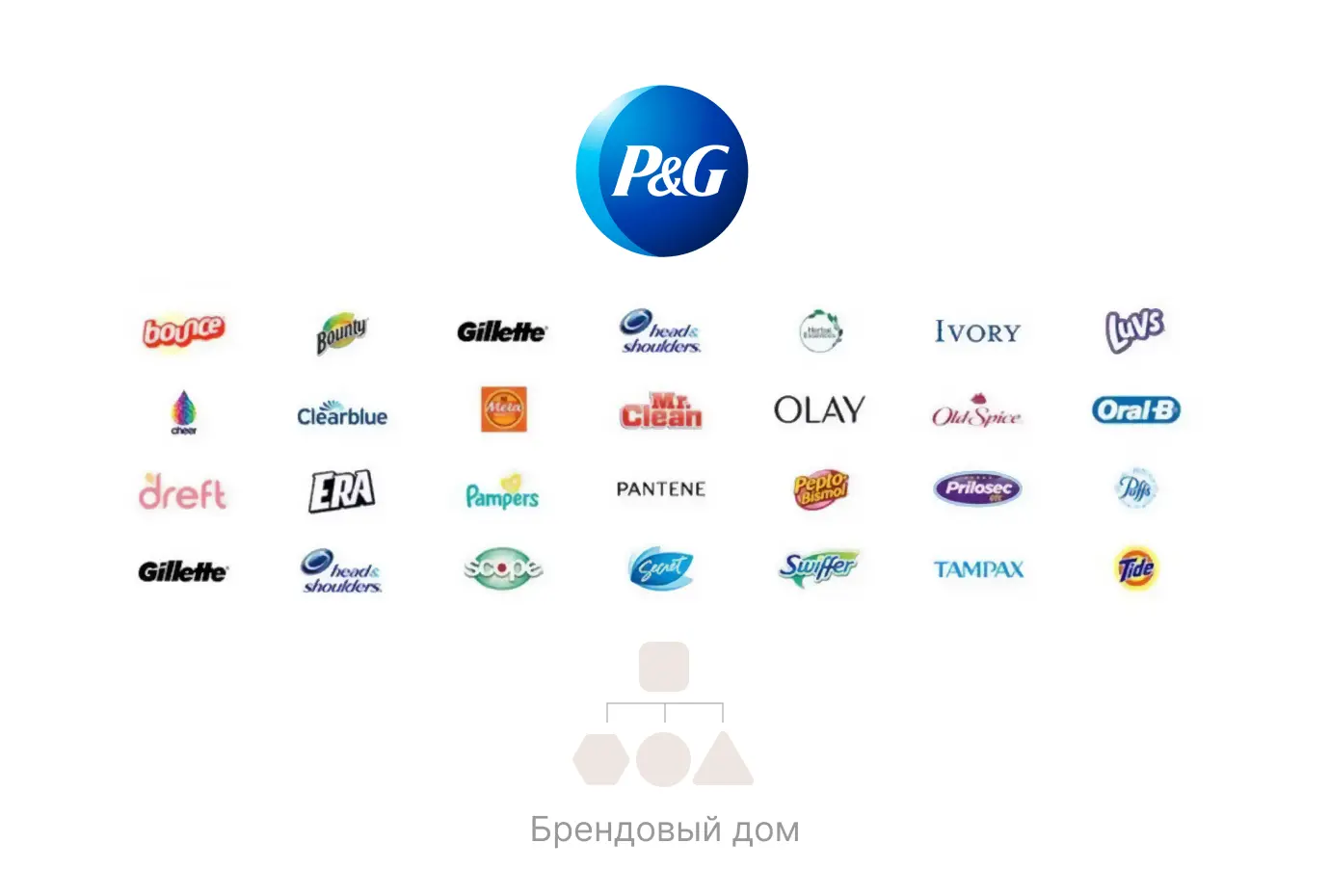
There are two main principles for building brand architecture. The first is a house of brands. In this model, independent brands are united under the umbrella of one large parent company. For example, Disney brings together the Marvel and Pixar brands; General Motors — Chevrolet, Cadillac, Jeep, GMC; Procter & Gamble — Tide, Old Spice, Zest, Oral-B, Braun, Pringles, and many others. This brand strategy gives manufacturers more flexibility — allowing them to target individual brands at different audiences and to experiment with pricing, visual style, and the tone of communication for each sub-brand.
The main drawback of developing a brand platform of this type is the need to invest significant effort and resources into building each individual sub-brand, since its connection to the parent brand is relatively weak.
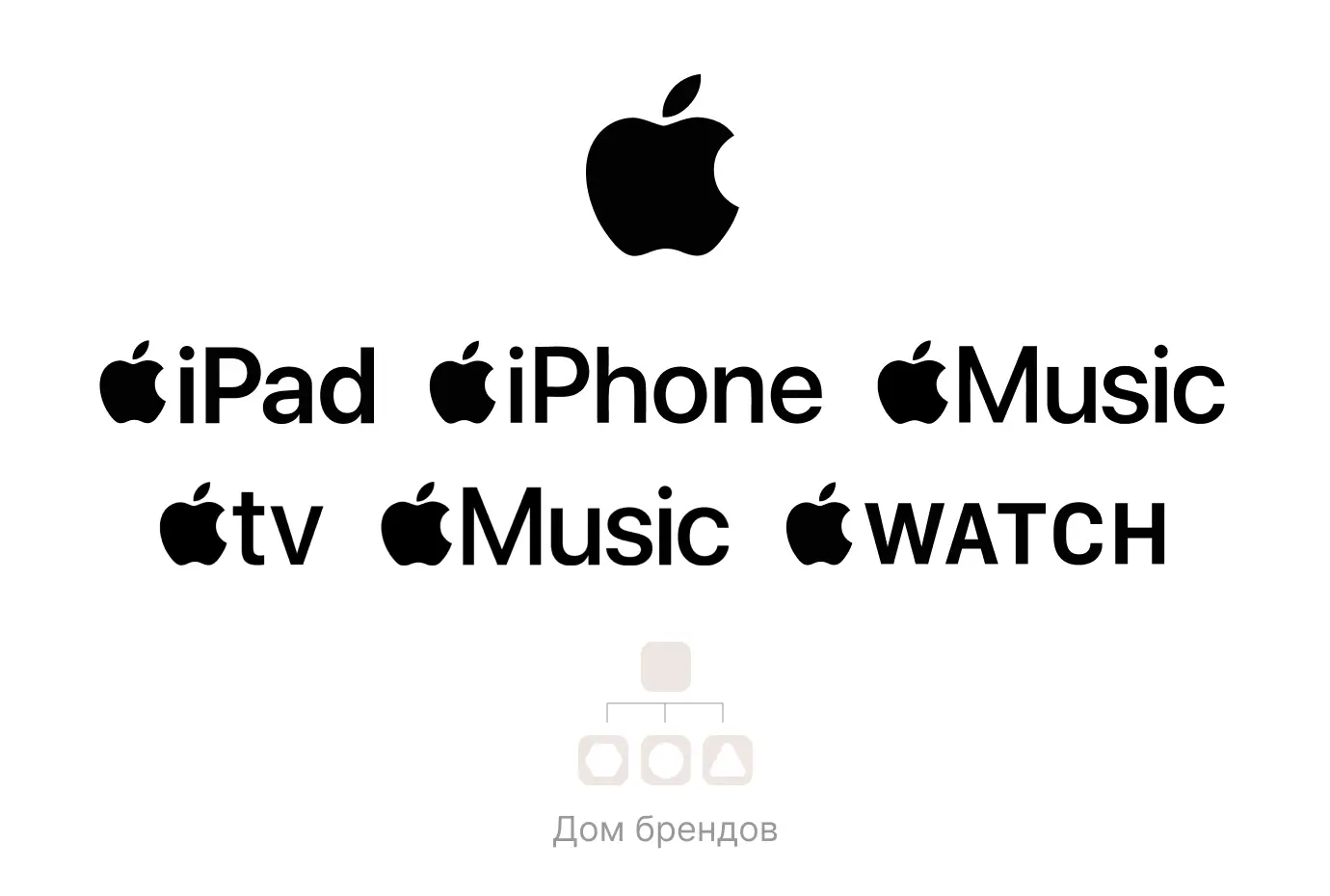
The second type of architecture is a branded house. In this model, sub-brands are derived from the parent brand. When creating a brand platform of this type, the main efforts are directed at supporting the parent brand’s image. As a rule, sub-brand names in this architecture are built on the principle “parent brand + sub-brand segment.” For example, the Apple brand includes Apple TV, Apple Music, Apple Watch, Apple Pay, Apple iPhone, Apple iPad, and others.
The advantages of this type of branding are lower costs for developing each sub-brand and for positioning in each individual case. The parent brand’s image and the positive associations it holds for the audience are automatically transferred to each sub-brand. But this is also the main disadvantage of the architecture: you cannot target individual elements of the product line at different price tiers, and you need to keep more or less the same characteristics across all products.
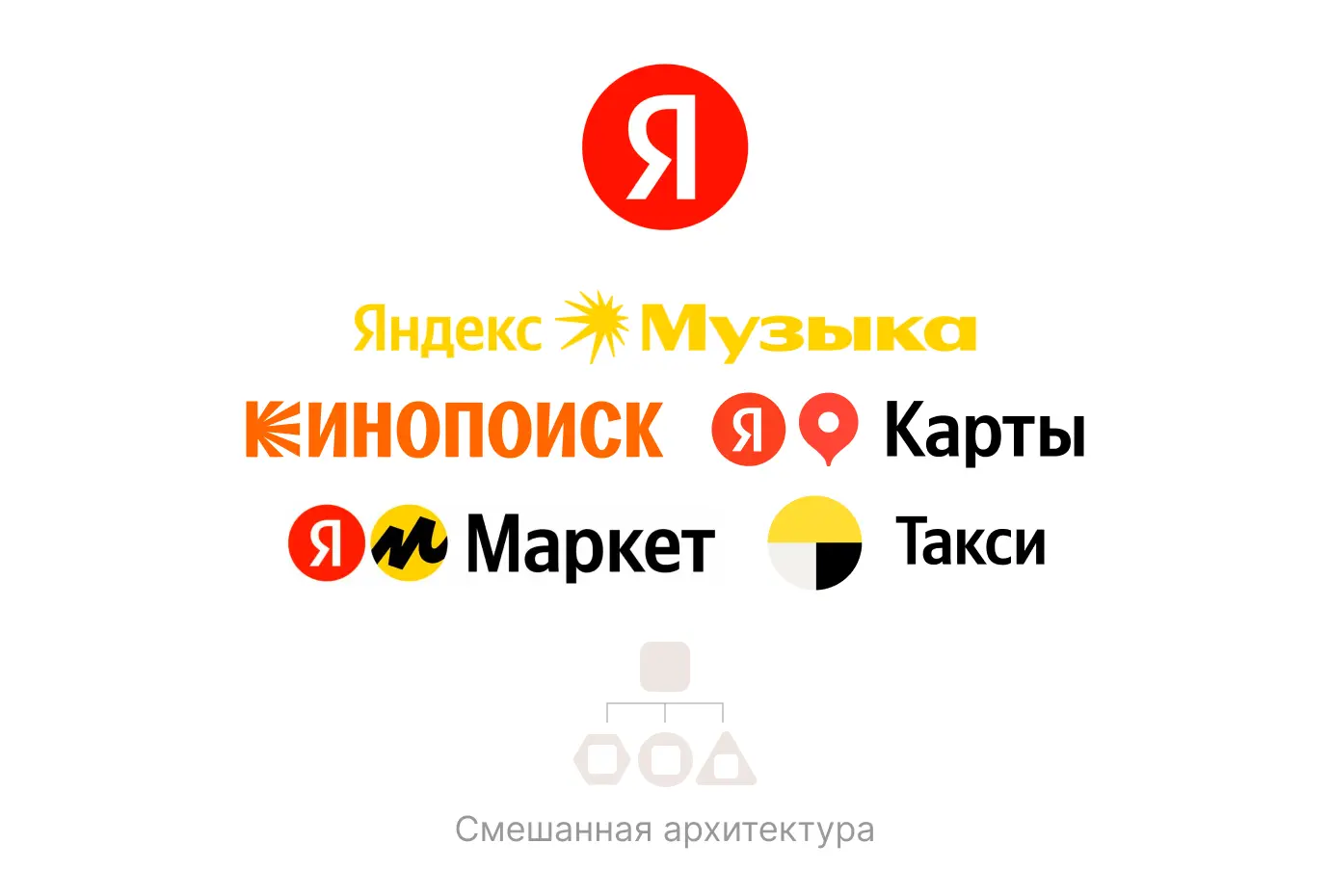
To have a brand strategy benefit from both approaches while trying to offset their drawbacks, some companies use a hybrid architecture when developing a brand platform.
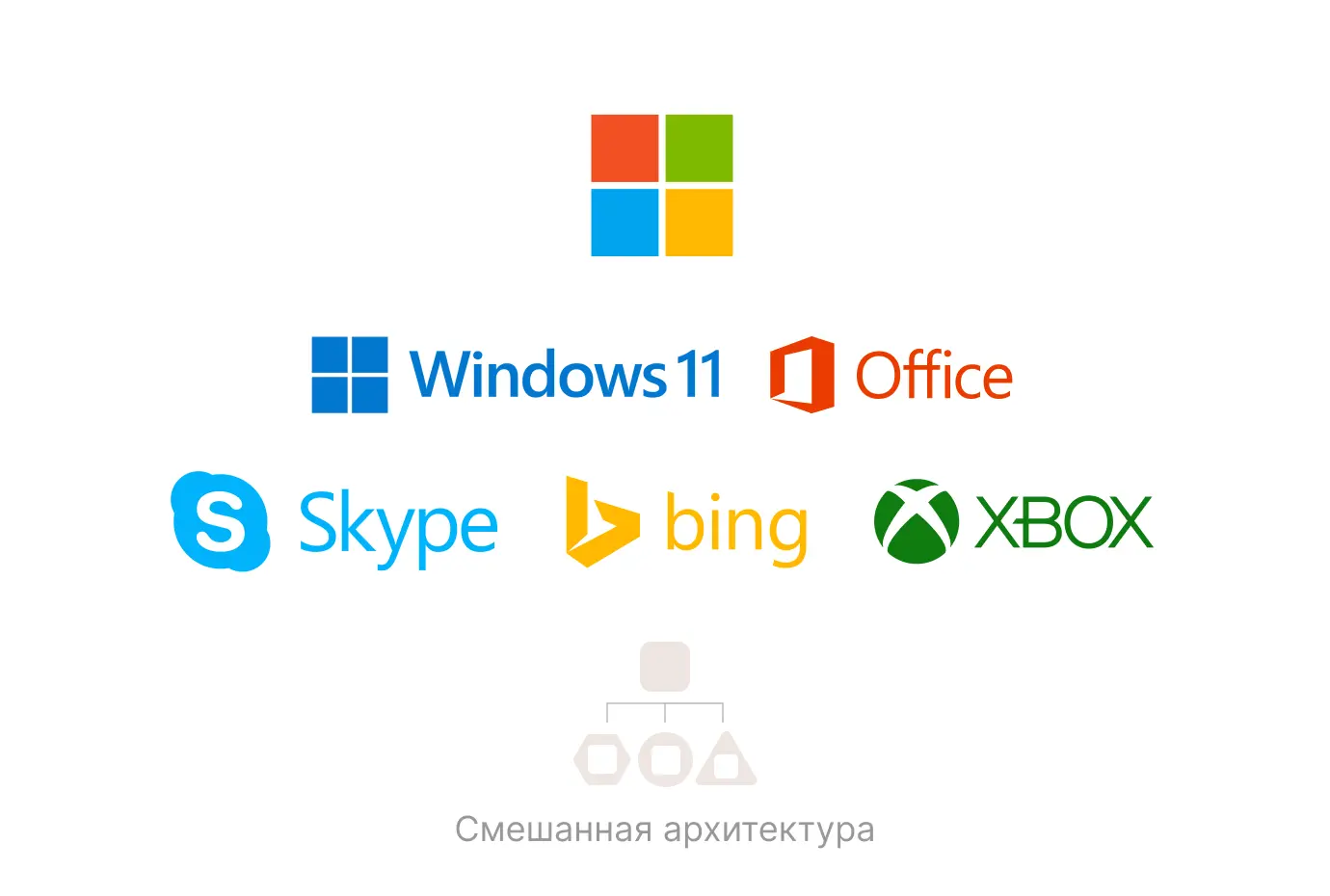
In a hybrid architecture, relatively independent sub-brands are used while maintaining a link to the parent brand and a consistent visual style. An example of a brand platform of this type is Microsoft, which includes the sub-brands Microsoft Windows, Microsoft Office, Xbox, Skype, Bing, MSN. Another example is Sony, which brings together Sony Playstation, Sony Xperia, Sony Pictures, and so on.





Brand Target Audience
A target audience is a group of people — or, more broadly, demographic segments — whose members already buy similar products or may potentially be interested in buying them. Defining the target audience is the starting point not only for developing a brand strategy, but also for creating the product itself. Understanding the needs, character, and motivations of the TA is essential for effective branding and for a product’s success in the market.
The overall target audience can be divided into two unequal parts:
Core (primary) — those who already buy similar products, and whose life circumstances are connected to the problems these products solve. The brand strategy is developed primarily for communication with them.
Peripheral (secondary) — those who are not currently consumers of such products, but may potentially become them. Usually, a brand devotes less attention to them due to their smaller size, but sometimes the brand strategy, on the contrary, implies expanding the core audience by bringing in new people from the peripheral segment.
For example, Converse’s core target audience originally consisted only of professional athletes, and the entire brand platform was built for them. Over time, it began to include non-professional basketball players as well. With the emergence of strong competitors such as Nike, Puma, and Adidas, the portrait of Converse buyers changed even more — the shoes became an everyday item and gained popularity among musical subcultures, and “counterculturalness” became an integral part of the brand strategy.
When defining the target audience, both socio-demographic and value indicators are analyzed. The former include:
Gender and age
Place of residence
Profession and income level
Marital status
Education
Building brand positioning based on socio-demographic characteristics is relatively straightforward, because the data is easy to verify and targeting methods are obvious (this is most clearly seen in the example of contextual advertising in social media).
Value indicators are harder to identify. They are partly related to socio-demographics, but can also be inherent in other groups. They are used to potentially expand the target audience or when the brand platform needs to be radically updated. These include:
Hobbies and interests
Values
Role models
Hidden motives
Tools for audience analysis can be direct (surveys, focus groups, interviews) — i.e., involving direct communication with potential buyers — or indirect (search analytics, analysis of posts in blogs and social networks). Clear target-audience targeting in branding makes it possible not only to increase sales, but also to build a more meaningful dialogue with customers, which helps create clearer brand positioning and will affect audience loyalty in the future.




What Is Brand DNA
Brand DNA is a set of value-based, communication, and visual attributes on which a brand’s positioning, its very essence, and its uniqueness are built. DNA is an alternative way to organize information about a brand and present it in a concise, visual form.
The set of components included in Brand DNA depends on the specific case. As a rule, the following characteristics that underpin the brand platform are highlighted:
Mission. A message about the company’s aspirations, its motivation, and goals beyond commercial ones. For example, Tesla’s mission is “to accelerate the energy transition worldwide.”
History. A brief description of the main stages of the company’s development, information about its founders, and the stages of launching key products that influence the brand’s positioning, its character, and values. For instance, Apple’s history emphasizes the innovative vision of its founder, Steve Jobs, and his colleagues, as well as the creation of the Mac and iPhone — devices that completely transformed the consumer electronics market and set new standards in their segment. The spirit of innovation and commitment to uncompromising quality are reflected in Apple’s branding.
Values. A set of qualities that define the essence of the company, its way of working, and how it interacts both with customers and with employees. For example, FedEx’s brand positioning is built around the values of speed, reliability, and customer centricity, while for Chanel it is classic style, sophistication, and a sense of premium.
Design. The logo, brand typefaces, and color combinations — everything that creates the brand’s recognizable visual image. An example of a brand platform is McDonalds, whose “golden arches” and the combination of red, yellow, and white are recognizable worldwide. In the same way, the three-pointed star, restrained color palette, and strict corporate typeface are among the key attributes on which Mercedes-Benz’s brand positioning is built.
Tone of voice. A description of the brand’s communication style with customers. It concerns not only word choice, but also the image the brand is trying to create. Slang and conversational language will never be used in IBM’s branding, but will definitely appeal to Snickers’ audience.


Examples of Brand Positioning
For a brand positioning strategy to be effective, all elements of the company must work toward its image. Whether we are talking about finding solutions for an international company or merely creating a personal brand strategy, the brand’s success in both the short and long term will directly depend on how precise and audience-aligned the positioning is.
An example of a clear brand positioning strategy that has been working for more than half a century is Volvo. Since the late 1950s–early 1960s, Volvo has consistently promoted its cars as the safest on the market.
The rational advantages on which the brand platform was built were technological innovations: it was Volvo engineers who invented a reliable seat belt design and a child car seat, which became a new standard for the automotive industry and have not fundamentally changed since. Exceptional durability of the cars in crash tests also became one of the pillars on which Volvo’s brand positioning was built.
These rational arguments were reinforced by a corresponding emotional message — Volvo was positioned as a family car to which you can entrust the life and health of your closest people.
To promote such a narrative, Volvo’s brand strategy implies the use of calm, neutral colors and minimalist typography in marketing materials, emphasizing the brand’s Scandinavian roots and focusing on simplicity, elegance, and functionality. Having found a successful positioning strategy, Volvo has adhered to it for more than 60 years.
Another example of a consistent brand positioning strategy that allowed a company to compete with the market leader is Pepsi. Until the 1950s, Pepsi’s brand positioning did not differ much from its main rival — Coca-Cola. But in the second half of the decade, the company’s branding began to change: in contrast to a competitor that embodied stability and family values, Pepsi’s brand strategy implied creating the image of a drink for a young, progressive generation.
The social upheavals of the 1960s in the USA and Western European countries were also used differently by the brands: while Coca-Cola’s brand positioning was a way to take a break from constant change through a classic taste that had remained unchanged for decades, Pepsi’s brand positioning was the spirit of a new era and a new “Pepsi generation” that came with it.
The updated brand strategy was reflected both in visual aesthetics and in the character of communication with customers. By adding a new color — blue — to its identity and removing the word “Cola” from its name, Pepsi made its design more aligned with the spirit of the new time and more distinct from its main competitor.
The face of the brand also changed — the company began promoting the drink through collaborations with music and film stars popular among young audiences. This brand strategy, with minor changes, has been used in Pepsi’s branding for more than half a century, allowing the brand to remain relevant and compete with Coca-Cola with a similar set of consumer characteristics.


Brand Positioning as a Way to Increase Sales
The absence of a well-thought-out brand positioning strategy does not mean an immediate failure of the product in the market and the company’s bankruptcy. However, such a product — even if it finds its niche at the start thanks to luck or favorable market conditions — is doomed to stagnation that will, in the future, turn into a sustained decline in sales in the absence of high-quality branding.
An effective brand strategy, on the contrary, can help a product stay afloat even in the presence of more experienced competitors with similar characteristics. This will happen due to the following factors:
Higher conversion rate. A recognizable image and clear brand positioning, communicated through the visual identity, will help deliver a greater return on advertising spend.
Building a loyal customer base. Companies that communicate, through their brands, a set of values close to their target audience achieve a significant increase in repeat purchases.
Reaching a broader audience. Such brand positioning helps significantly expand the segment of potential buyers. An example of a brand strategy with this approach is transforming a narrowly specialized product into a lifestyle brand by linking consumer interest not to the product’s objective properties, but to the images it communicates.
Increasing price resilience. Strong brand positioning makes it possible to keep a product’s price above the market average (except in cases where the core strategy is price competition). This leads to revenue growth, and any subsequent increases will be perceived less painfully.
A comprehensive brand positioning strategy helps increase sales for established trademarks; thoughtful branding gives new products a powerful start.
For example, in the early 2010s Samsung launched the “The Next Big Thing” campaign, intended to highlight the technological sophistication and innovative design of its new smartphones as a worthy alternative to the iPhone. By updating its brand positioning in this way, Samsung’s share in the smartphone market grew from 8 to 31%, the brand took the leading position in sales, and it still holds that position to this day.





Developing Brand Positioning: Preparatory Stages
Although developing brand positioning is, to a large extent, a creative process, it relies on objective characteristics of the brand — its position in the market, competitors’ successes, the income and preferences of the target audience, and the opportunities and threats for the company’s further growth. The analysis of these factors always precedes the creation of the brand strategy.
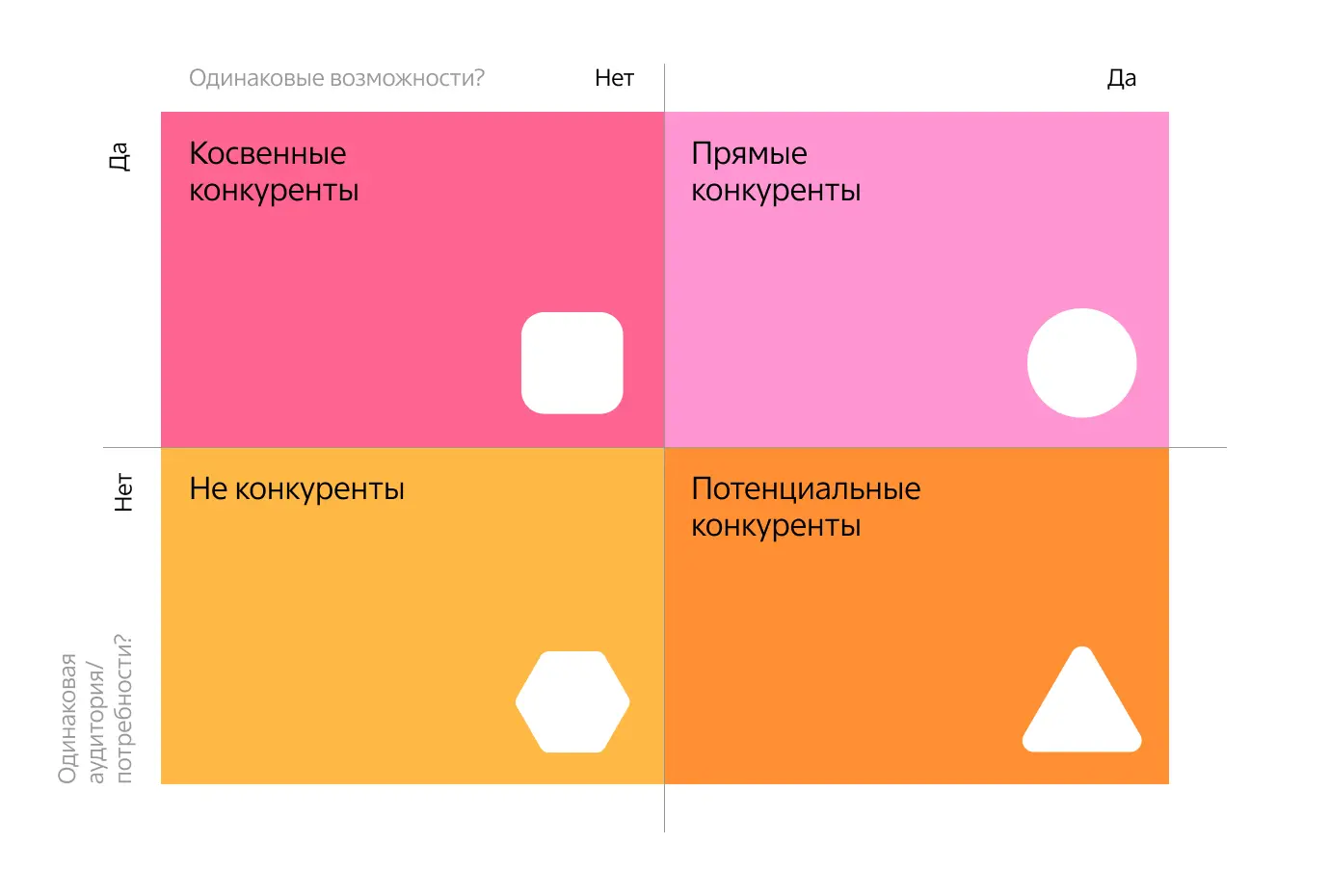
Competitor Analysis
With rare exceptions, a product already has analogs on the market — from two or three to several dozens, or even hundreds. At the same time, substitute products are obviously not completely identical: price differs, consumer characteristics differ, and their brand strategy differs as well.
When developing a strategy for a new brand, competitors in relation to your offering can be divided into three groups: direct, indirect, and potential. As part of developing brand positioning, select ten leading companies in the segment and answer two questions for each of them:
Are their capabilities and capacities similar to yours? Compare formal indicators: company size, approximate budget, sales volume, headcount, geographic coverage, technological level, and so on.
What problems does their product solve? A less trivial task: assess not only formal, but also value-based criteria. An example of iPhone brand positioning is a smartphone, but also a symbol of commitment to innovation, and in a number of regions — a marker of higher income.
By distributing competitor brands according to the answers, you can understand which of them you will have to compete with first; the brand platform will, to a large extent, be built on this assessment.
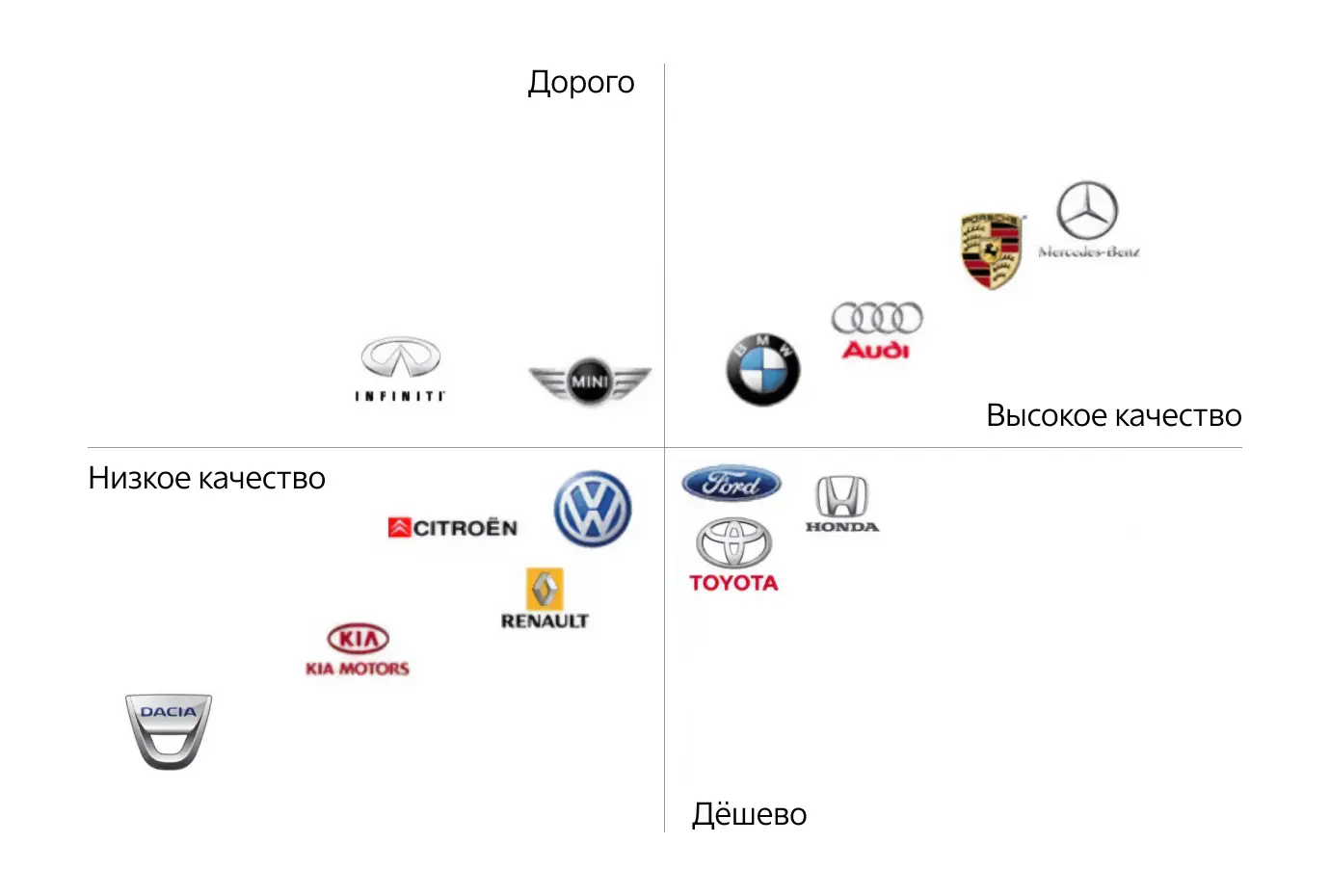
Not in all cases is it possible to unambiguously assess the properties of each individual brand. Often, for greater clarity in the development of brand positioning, several companies are compared using a positioning map. To do this, select two key characteristics of the product group and place the brands on the vertical and horizontal scales relative to them. As a rule, price and a certain averaged “quality” are considered.
A positioning map provides a clearer picture of the balance of forces in the market. It is a good tool for developing a brand strategy because it clearly shows which companies are your direct and indirect competitors, makes it possible to analyze their branding, and helps determine the desired niche. If necessary, other characteristics can also be compared — not only material, but also value-based — especially if you plan to rely on them when creating the brand platform.
SWOT Analysis
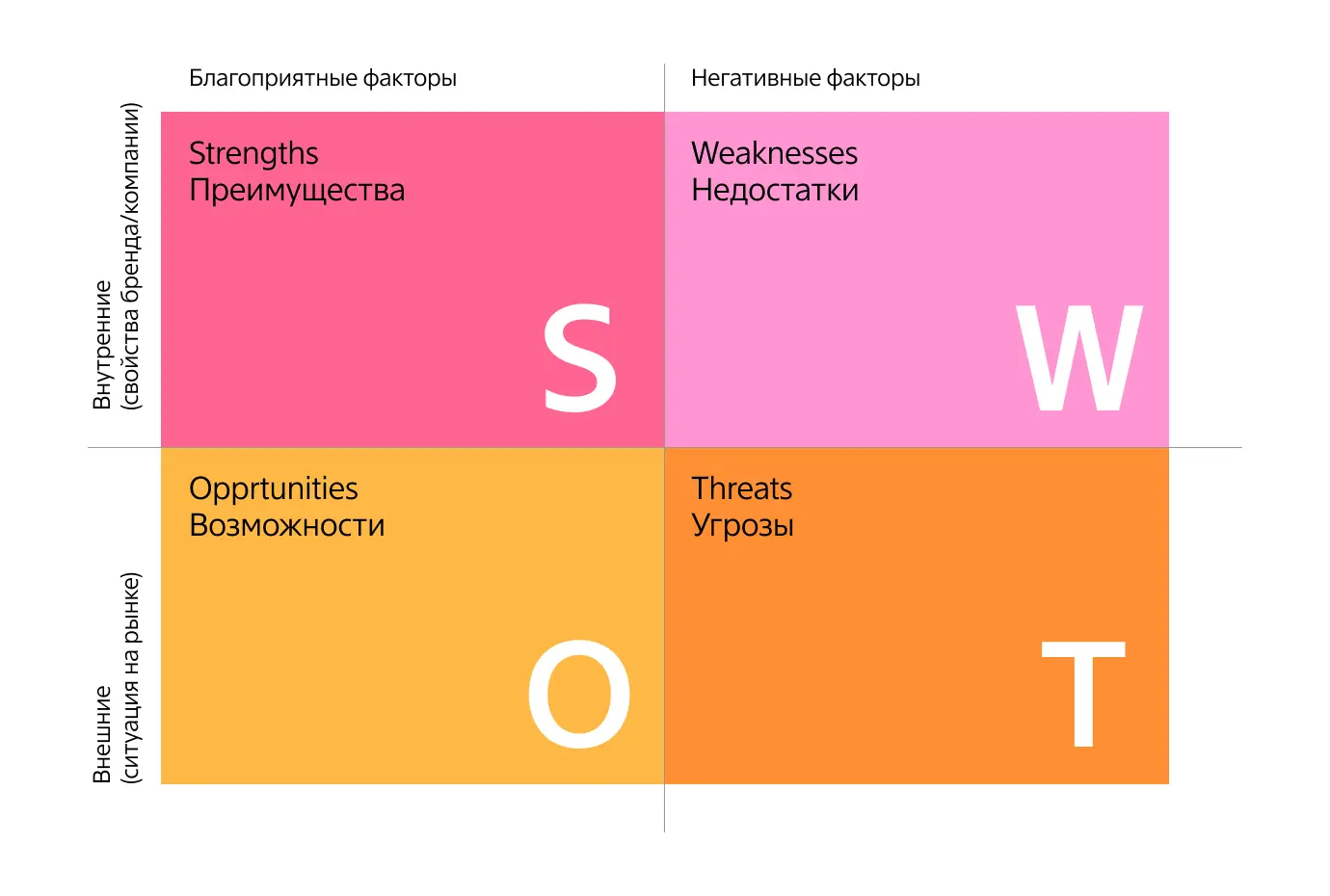
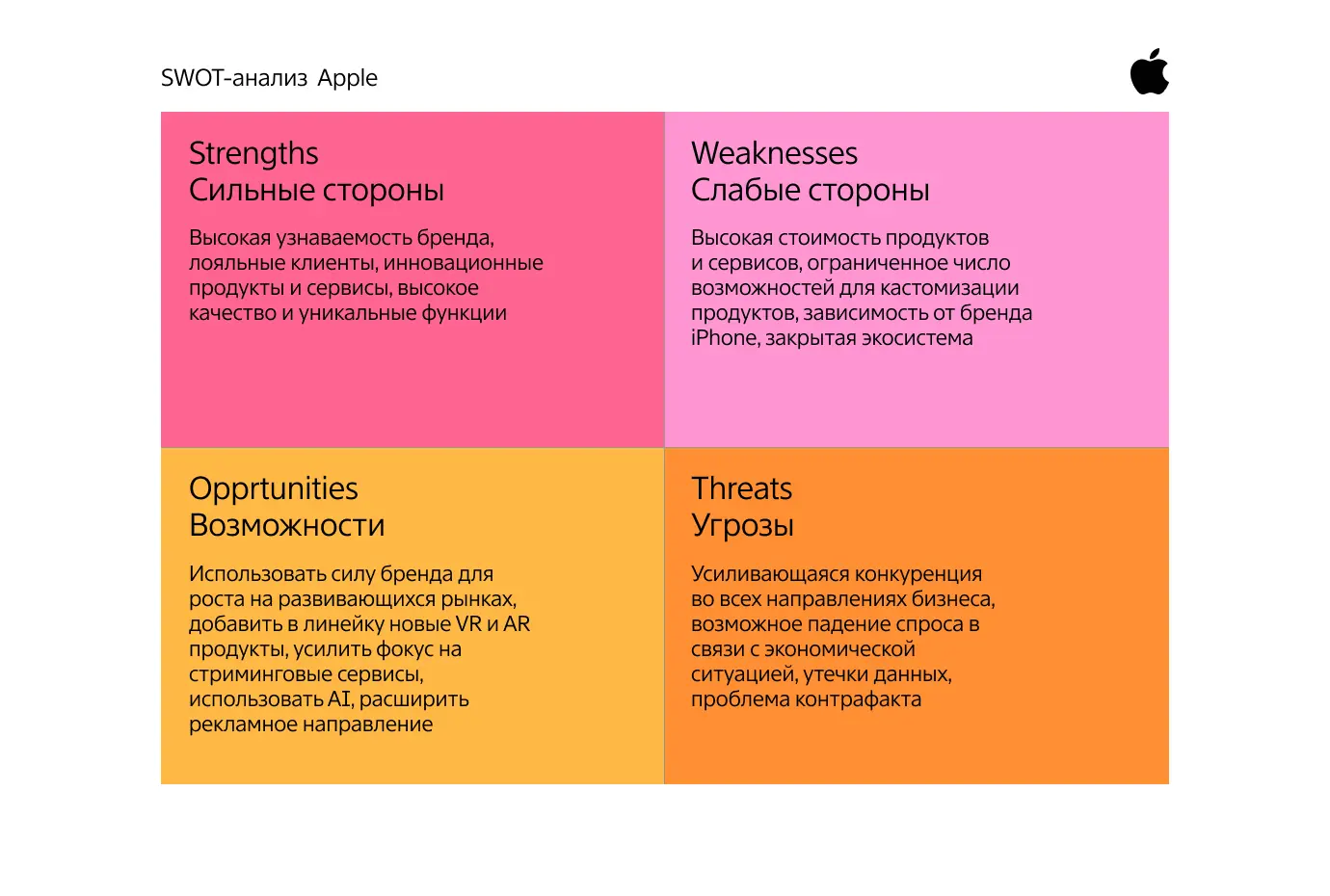
After you have identified the main competitors and chosen the desired place of the brand in their hierarchy, you can move on to a more detailed assessment of your own advantages. A good tool for this task when creating a brand strategy is the SWOT analysis. It helps identify the company’s strengths (Strengths) and weaknesses (Weaknesses), as well as opportunities (Opportunities) and threats (Threats) for further development.
Evaluate the pros and cons of the product and the company as a whole, and assign them to these four fields. Treat advantages and disadvantages as internal factors — those related to the product itself — and opportunities and threats as external factors, driven by the state of the market, competitors’ positions, and so on. Brand positioning will be built based on these.
SWOT analysis is a universal tool: it can be used to evaluate any brand — not only a company, but, for example, the brand of a city or a non-profit organization. This matrix makes it possible to see a company’s strengths and issues in a concise and clear form and to create a brand platform. It simplifies the selection of strengths on which the development of a brand strategy will be based, or, if such strengths do not yet exist, it helps outline ways to develop them.
At the initial stage, a brand strategy can, as a rule, be built on a simple quantitative analysis — that is, by listing factors and placing them into the matrix sectors. Later, a more complex analysis — qualitative or correlational — can be conducted to examine each of the identified points in more detail and to study competitors’ branding.




Building the Customer Persona When Developing a Brand Strategy
In addition to competitor analysis and assessing your own pros and cons, developing a brand strategy should also include building a customer persona. This is necessary for a detailed understanding of the future buyer’s expectations, needs, and the problems the product can solve.
There is no single fixed list of characteristics used when building a customer persona, but for any product or service an entire set of parameters may be considered. Among the key ones are gender and age. These are basic characteristics of a potential customer that broadly segment the target audience and directly influence brand positioning. For example, a cosmetics brand platform will be oriented primarily toward a female audience, but preferences can differ quite strongly across different age groups.
Thus, teenagers (13–19 years old) will be more interested in acne treatments and trend-focused cosmetics from small independent brands. Young adults (20–35 years old), in addition to this, will also be consumers of various types of facial skincare. The older age segment (35–55 years old) is more likely to choose familiar, larger brands and will also pay attention to anti-aging products. When developing brand positioning, it is necessary to account for all possible consumer segments and build in the possibility of expanding their number.
Another important parameter is profession/field of activity. Professional interests and the needs associated with them are also among the most obvious parameters when developing brand positioning. This applies equally both to a person’s place of work and to social roles associated with characteristic activities and interests (homemaker, retiree, student, etc.). These are among the key attributes on which the brand platform is built.
Another simple way to segment the target audience is income level. When developing brand positioning, it is necessary to assess not only the potential buyer’s overall income level, but also the amount that will be acceptable for this segment as a spending level for a specific product.
It is also worth paying attention to consumer habits — typical patterns of how the buyer interacts with the brand: loyalty, willingness to try new things, inclination to impulse versus planned purchases, and so on. Habits are shaped both by demographic and social factors and by more individual personal and psychological characteristics. The brand strategy should take current consumer trends into account and also analyze possible changes in them. This point is especially important when developing strategies for new brands, where consumer preferences have not yet fully formed.
Another important factor is marital status. Having — or not having — a partner and children directly affects both the formation of consumer habits and the buyer’s heightened interest in certain product categories (children’s goods, family leisure, etc.) and, consequently, the branding of products in these categories.





Types of Brand Positioning Strategies
In branding, there are several fundamental brand positioning strategies. With minor changes, they are used in most advertising campaigns. Depending on the specific case, they can be modified, but their basic principles remain unchanged.
Positioning by attribute. The most basic and widespread strategy. The unique selling proposition of a product or service is communicated by focusing on one of its attributes. This attribute may relate to either rational or emotional characteristics of the product. An example of a brand strategy using this approach is the updated image of Sber. Sberbank retained its classic slogan “Sber. Always nearby!” after a large-scale rebrand. With the launch of a digital ecosystem, the slogan gained a new context (instead of a wide network of bank branches, it now appeals to a set of different services—from streaming and grocery delivery to insurance and cloud solutions), but the key message on which the brand platform is built does not change. Sber aims to be present everywhere and always be accessible to its customers.
Positioning by benefit. The main focus is on a problem faced by potential buyers and on how the product solves it. Brands of medicines and household chemicals often use this strategy for promotion. When developing brand positioning, the most important work is with consumer insights. An example of a brand platform using this approach is Volvo, which emphasizes maximum driver safety in its positioning. Another brand platform built in a similar way is Nike, where the buyer is communicated an emotional benefit from self-overcoming and a sense of belonging to sport.
The strategies of positioning by attribute and by benefit are similar — in both cases, they are based on the core, essential characteristics of the product. In the first case, the brand’s advantage is only declared; in the second, it is explicitly presented as a solution to a typical problem of the brand’s target audience. Both strategies are not very effective in markets with a high level of competition (because any advantages are copied relatively quickly), so successful brand positioning should combine several approaches at once.
Positioning against competitors. This strategy involves direct comparison with competitors and differentiation through opposition. The brand offers a new way to solve customers’ problems, or simply does the same thing as competitors, but better. As a rule, this brand strategy is used to enter or expand in a market where there is already a monopolist or a narrow group of strong players. Here one can recall the classic confrontation between Apple and IBM, or Tele2’s attempt to push aside the three giants of mobile communications in the mid-2000s.
Positioning by category. This approach focuses on the brand’s leadership within a particular product category. This leadership is achieved either through overall superiority in the standard characteristics for the category, or through innovations that offer a radically new experience. Brands that choose a category-based positioning strategy often become household names. Examples of brand platforms built on this principle include Xerox, Coca-Cola, Google, Thermos, and others.
Positioning against competitors and positioning by category also have much in common — in both cases, the emphasis is on differentiating from similar brands. The first strategy works for those who aim to displace the market leader (without necessarily taking its place). It is often used when developing strategies for new brands. The second suits those who already hold leadership positions or are confident they can quickly achieve and then maintain leadership in the long term.
Positioning by audience. The main focus of this strategy is a specific target group of buyers. Audience segmentation can be based on age, gender, income, profession, or other parameters. The goal is to make the brand an integral symbol of belonging to this group and to build the entire brand platform on association with it. For example, in the electric guitar market there are at least a dozen major players, but if you are a guitarist it is practically impossible not to encounter the Fender brand — a pioneer of the industry and the default choice for most musicians. Another example of positioning by audience is Tochka Bank, created for entrepreneurs, oriented toward the needs of small businesses and individual entrepreneurs, and offering additional services that make their activities easier—online accounting, support for tenders, and so on. In the United States, a similar brand strategy is used by Stripe—it presents itself as a bank for web designers, startup founders, and all those who need a payment solution for a website or an application.
Positioning by usage situation. The goal of this strategy is to create a strong associative link between the brand and a specific situation in which it is used. An example of brand positioning in this way is the GoPro action camera. It does not matter whether it is used in extreme sports competitions, in a travel blog, or to film individual scenes in a movie — it will always be the first-choice brand in its segment.
Positioning by audience and positioning by usage situation also share many similarities — both start not from a property of the product itself. For the first, branding will mainly be based on the characteristics of the target audience (which makes the potential audience narrower). For the second, it is based on the circumstances of the situation in which the product is used (which creates potential for audience expansion). There are relatively few people who play guitar, but they are a community with fairly stable consumer habits. There are far more buyers of laundry detergent, but there are also many subgroups within that audience.
Positioning by price-to-quality ratio. In this strategy, the product is positioned as the optimal set of characteristics within the stated price segment. As a rule, the strategy uses the model “a high-quality (though clearly not premium) product at a price lower than one might expect.” But it also works for luxury brands. A classic example of a brand strategy is IKEA, which has become synonymous with the combination of concise Scandinavian design, decent build quality, and low prices. Azbuka Vkusa has a different positioning — this supermarket chain promises customers a significantly more refined assortment and fresher products at prices slightly above the market average.
As with archetypes, most brands combine several positioning strategies at once in different proportions.





Brand Strategy as a Continuation of the Positioning Strategy
Positioning is the foundation of a brand. But as the number of marketing communications grows, a positioning statement and briefly formulated values become insufficient — for further development, a brand strategy is required.
A brand strategy is similar to a positioning strategy, but it is a more comprehensive document that includes:
Information about the brand essence. The idea, archetype, vision, mission, brand positioning — everything that conveys the product’s meaning and the image it wants to create.
Values and principles. Guidelines covering the standards and rules the company follows both in interactions with customers and in corporate communications, and on which the entire brand platform is built.
Visual and verbal communication. A detailed description of attributes — not only the logo, slogan, brand colors, and typefaces, but also examples of how advertising materials, retail spaces, and internal corporate communications are designed, based on the brand positioning.
Market environment. A more detailed (compared to brand positioning) analysis of competitors, the current market situation, and target audience segments.
A brand strategy is a comprehensive analysis of all elements of the product and the company through the lens of positioning. All attributes of the product are brought to a single semantic and visual denominator in accordance with the formulated brand idea.




Brand Platform — a Concise Portrait of the Brand
A brand platform is another way to present, in a relatively condensed form, an understanding of the brand—its essence, mission, values, and visual style. A brand platform is not as detailed as a brand strategy; rather, it is a more detailed disclosure of positioning, supplemented with visual references (but, as a rule, not specific examples of advertising communications, banners, etc., but instead images that help convey the brand’s aesthetic).
A brand platform makes it possible to get acquainted with a company, the aesthetic of its products, and its fundamental values, and to understand the essence of the brand. A brand platform should take into account the company’s market position and its intended marketing strategy, but in the platform itself these are generally not described in detail. While a brand strategy is intended to examine the subject from all sides, the brand platform primarily speaks about meaning and identity. As a rule, a brand platform is designed as a brand book or a set of guidelines that in detail describe the principles of branding.
Structurally, a brand platform resembles a pyramid to some extent. There is no single format, but there is a set of categories that it typically includes.
First and foremost, the platform reflects the brand’s essence — a brief description of the brand’s core idea and its essence, formulated in one, maximum two phrases. Within a brand platform, it can be presented in the form of a slogan and supplemented with visual references.
The platform reflects the brand’s attributes. This includes information about the brand’s visual markers, as well as its tone of voice. The goal of a brand platform is to bring all elements of the visual identity together into a single concise document that lets you, at a glance, feel the company’s visual style and its semantic charge.
Usually, a brand platform focuses precisely on the meaning embedded in the logo, typefaces, brand colors, and other branding elements, without paying special attention to layout rules and other technical details.
A company’s tone of voice is described in the brand platform both through the vocabulary used in advertising and through information about the planned types of communication, advertising placement contexts, and so on.
The platform also incorporates the brand’s values — a set of ideas and principles that the company follows when interacting with customers and building internal processes. A brand platform is designed to clearly record the practices that have developed within the company so that later all its departments — from marketing to customer support — can align their activities with them and maintain the chosen development vector.
Also, the brand platform and the values reflected in it can serve as a kind of declaration of intent if a company has gone through a rebrand and intends to change the principles of how it operates.
The platform reflects the brand’s vision: it records not only the current but also the desired position of the company, and it describes its idea of success and the paths by which it intends to achieve it. Quite often, a brand platform is used to mark an updated development path for a company, outlined after repositioning or rebranding.
The platform specifies the brand’s character — a list of emotional characteristics inherent in the brand and its products. As a rule, a brand platform reveals it through several parameters. First, it describes the brand archetype. In the case of a more complex image, the brand platform may contain information about several archetypes at once, used to different degrees in shaping the brand’s style, its visual and meaning content. Second, character manifests through the ideal image of the buyer. The brand platform describes several target audience segments, each of which corresponds to a certain image connected to the brand’s character.
A brand platform is a universal document that allows you to quickly get acquainted with a brand and understand its essence. It speaks not so much about the factual characteristics of the product (though partly that as well), but about the emotions the brand communicates.
In practice, a brand platform is a kind of memo for everyone who is, in one way or another, involved in the company’s work. As already mentioned, it is useful during rebranding — but not only: it is also useful when scaling a business, entering new markets, or moving into new fields of activity. A brand platform helps a company remain true to its principles and aesthetic, keeping brand positioning and the advertising message clear.
The platform also makes it possible to coordinate all advertising activities with the company’s overall operating principles: the brand platform serves as a reference point both for the marketing and design departments and, for example, for the HR department.


Criteria for the Effectiveness of Brand Positioning
There are several directions along which the effectiveness of brand positioning can be assessed. The most obvious is the analysis of product metrics and the company’s overall metrics. As a rule, when developing a brand strategy, these are considered first. This is especially important when developing a strategy for new brands.
The following groups of parameters can help determine how well a product is presented to the audience:
Customer loyalty and engagement. These include the frequency of repeat purchases (repeat purchase rate), the customer attrition rate, the level of customer retention (customer retention rate), the level of customer loyalty (net promoter score), and brand awareness, measured through surveys. They are analyzed at the early stages of developing brand positioning.
Online activity. It can be assessed through metrics such as website traffic volume, click-through rate and conversion in contextual advertising, and target-audience activity in social networks (likes, reposts, comments, and so on). It often becomes the main tool when developing a personal brand strategy.
Overall financial and marketing indicators. In addition to the most obvious indicator — revenue growth — it is also worth assessing average order value, the dynamics of the relationship between the target and the actual audience, and the share of the market occupied by the brand. As a rule, macro-level indicators are incorporated into the brand strategy.
Product and marketing metrics are not the only tool used to analyze the effectiveness of brand positioning. Focus groups can also be used, formed both from potential consumers and from representatives of the brand’s industry.
As a rule, this method involves evaluating several brand parameters on a scale from zero to ten, followed by summing the points. The evaluated characteristics may differ depending on the details of the study and the goals of the brand strategy, but the most common include:
The uniqueness of the brand, its dissimilarity to competitors
The integrity of marketing communication, consistency in the company’s actions, and the precision of the brand strategy
The match between the target audience and the brand positioning
Emotional response to the positioning attributes
Willingness to recommend the brand
There is no single universal system for assessing effectiveness; the set of metrics considered depends on the size of the company, its resources, and how much attention is paid to marketing. A professionally prepared brand positioning strategy will have a positive effect on all of the indicators listed above.

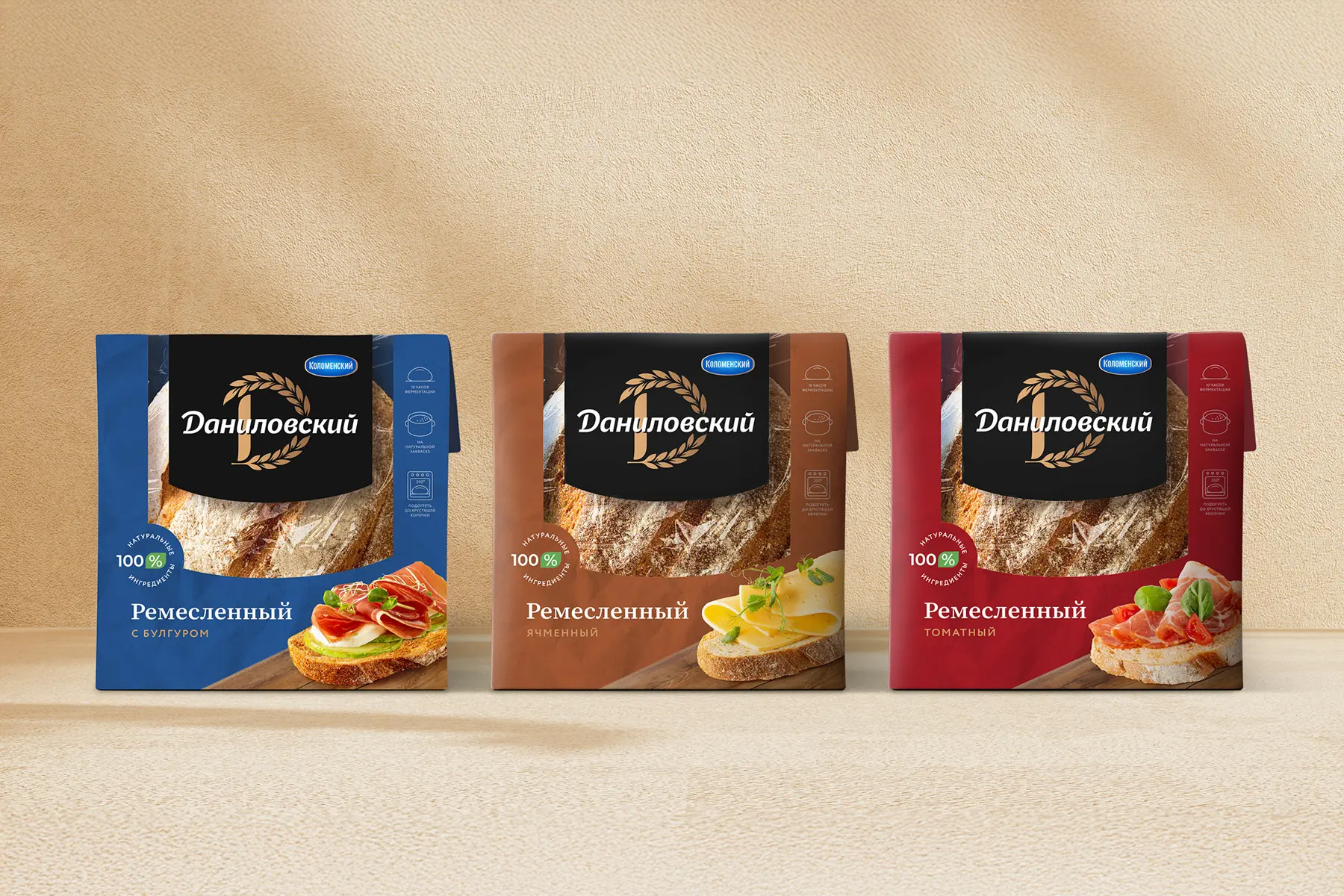


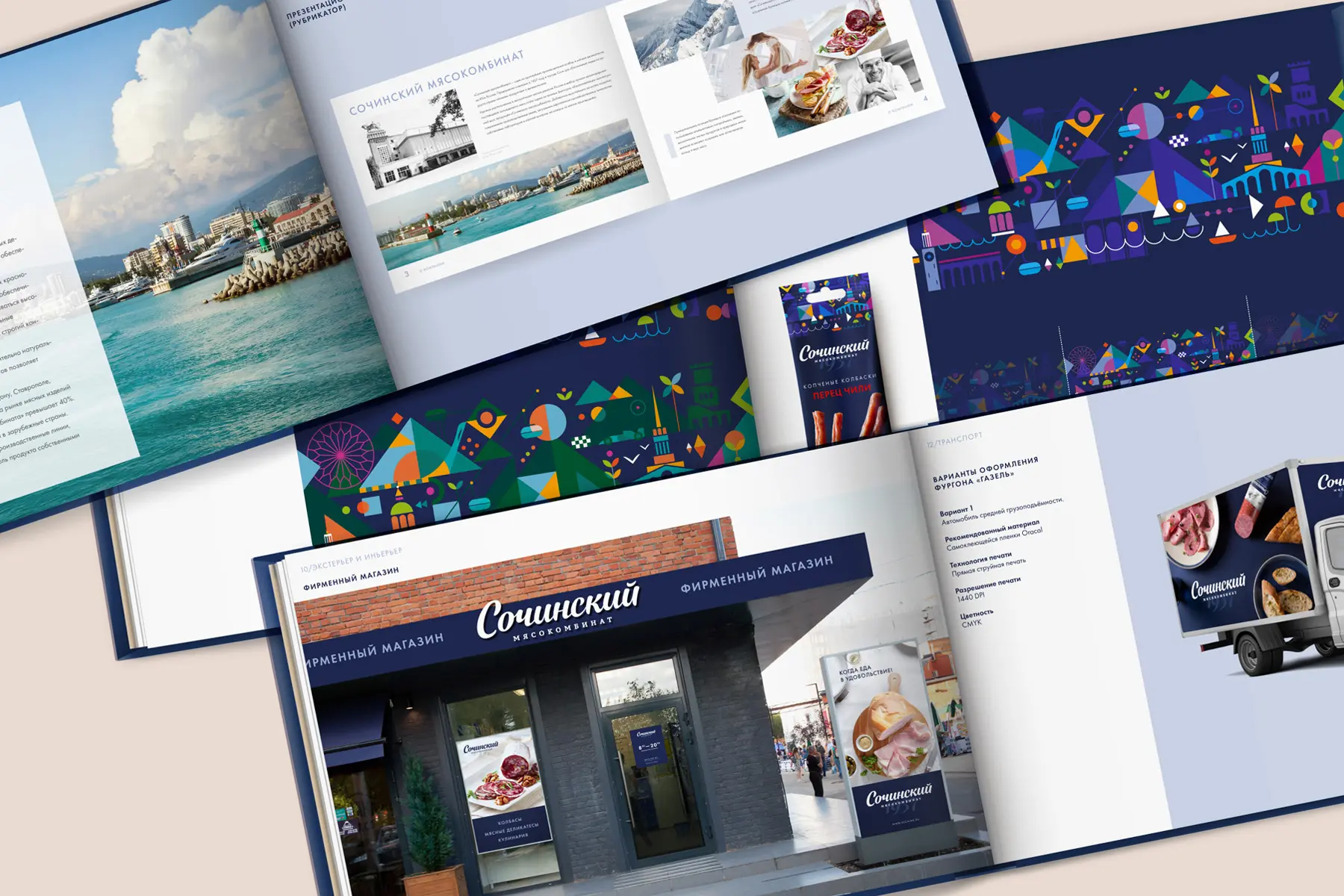
Further Work with the Brand: Repositioning and Rebranding
Even the most successful brand positioning strategy eventually requires an update, and in some cases a radical rethink. Repositioning is usually triggered by the following factors.
Initially insufficient work with the brand. This situation is typical of a growing small business. At the initial stage, a company may launch without developing a brand strategy and even achieve limited success, but later a well-designed brand strategy becomes a necessary condition for attracting new customers and strengthening loyalty to the product.
A blurred message. Also, in small businesses the brand strategy is often developed in-house, and as a result it turns out to be insufficiently cohesive. The brand message becomes unclear, or there are too many messages being communicated, which pushes customers toward competitors with a well-built image. Despite seeming simple, developing a brand strategy is a long and labor-intensive process with many nuances, which is better entrusted to professionals.
The appearance of new products in the line. As the company develops, it launches new products, and the original brand positioning may not take into account their characteristics and image. If there are many such products, the very essence of the brand will begin to change, which will also require adjustments to the strategy.
Changes in the company’s structure and its operating principles. Internal processes in the company can also affect brand positioning. A startup that has grown into a large firm, or an industry leader that has decided to add a new line of business to its portfolio, will be perceived differently by the audience. The brand strategy must also reflect these changes.
Reaching a new audience. For one reason or another, the customer profile has changed—old customers have grown up, developed new habits, and so on. Or perhaps the familiar audience has not gone anywhere, but the growth limit within it has already been reached and new markets must be sought, which requires making adjustments to the brand strategy.
A decline in sales. From time to time, even high-quality products with a long history reach stagnation or even a drop in sales. If the product’s consumer characteristics are not the reason, the culprit may be an outdated marketing image that fails to communicate all the brand’s advantages to the audience. Developing brand positioning implies relying on the product’s existing ideological heritage, but sometimes it is better to partially or completely abandon it.
The emergence of new competitors. Developing brand positioning for a specific market situation will not make sense if the balance of power in the industry changes—new players may encroach on your niche, and former non-competitors, having changed their own positioning, may become competitors.
For the same reasons, but in cases where updating the brand positioning strategy is not enough, more comprehensive work is carried out—rebranding. Rebranding involves a complete change in both the semantic and the visual components of the product; that is, in addition to repositioning, a restyling or redesign is carried out—changing typefaces, brand colors, the logo, and so on.
As a rule, a brand’s visuals are updated more often than its essence. Outside the professional environment, rebranding is often understood as work specifically with just one of the brand’s components (so-called partial rebranding).
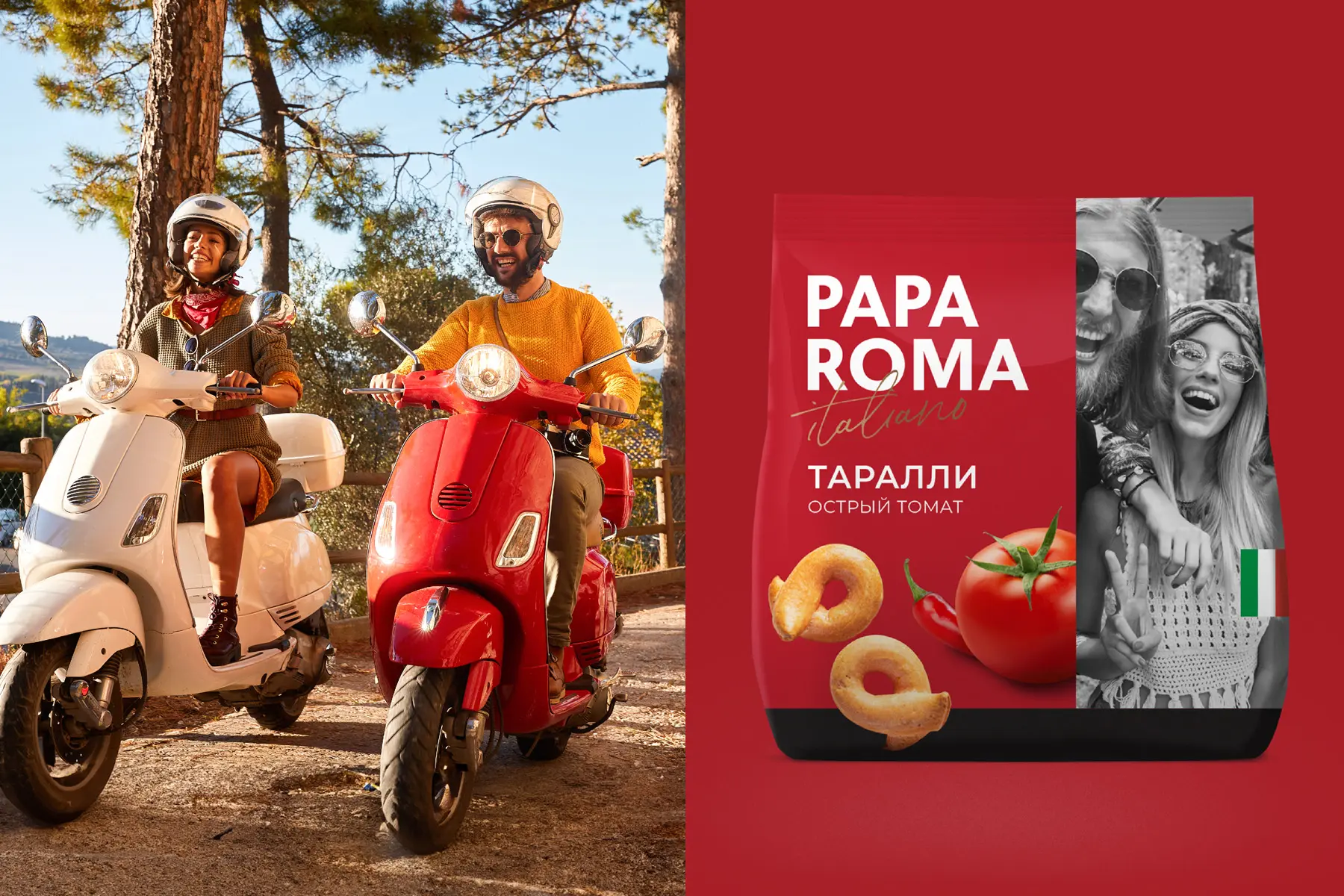


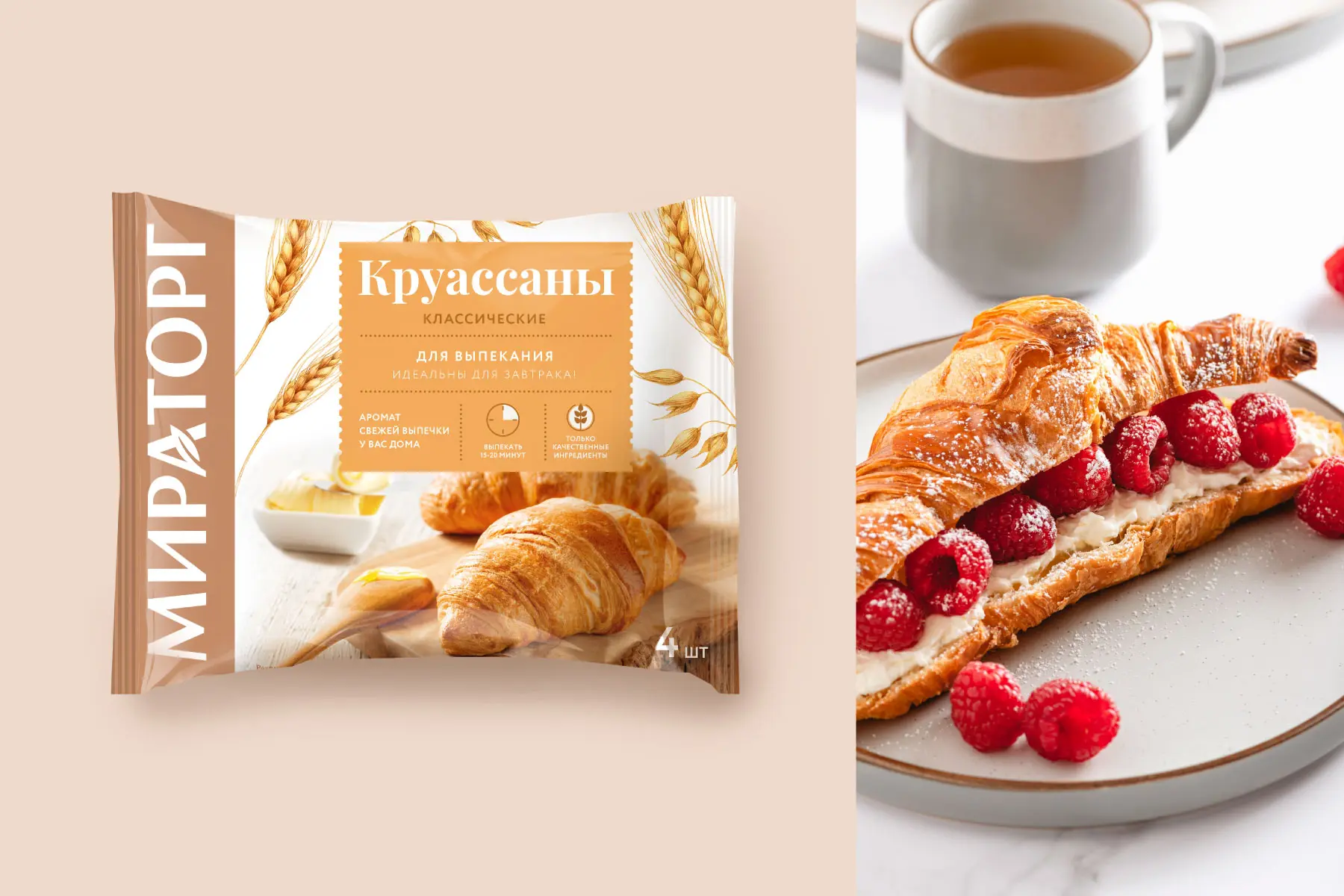
Brand Positioning Brief
Before starting work on developing brand positioning, it is worth summarizing the key information about the brand. This will help the client and the agency better understand how they see the product’s current image and what they want to achieve in the end.
This can be done by answering the following questions:
What is the brand’s USP (unique selling proposition)? What are its strongest sides?
Who are the main direct and indirect competitors? What are their advantages and disadvantages? Will their list change after the new positioning is developed?
What is the brand’s current and planned product assortment?
Market environment: what is the situation in the industry, what are the main trends, what do customers typically prefer?
Target audience: who is it? Is it cohesive or divided into segments? What are its main characteristics (socio-economic, demographic, professional, etc.)?
What is the typical usage/consumption situation?
Functional field: what are the product’s functional features, and which of them does the customer perceive first?
Social field: with which social group does the customer identify when choosing the brand?
Mental field: how does the brand affect a person’s perception of themselves, what personal feelings does it evoke?
Spiritual field: what non-functional values is the brand associated with, and which of them should be emphasized?
Developing a brand strategy takes place in several stages. Usually, the first meeting discusses general questions—the desired brand positioning, the current visual style, the budget, and so on. Next, the agency together with the client reviews references of similar brands; this helps the client more clearly define their priorities and show which identity styles are closer to them. The next stage of developing the brand strategy is the approval of the Terms of Reference (ToR) based on the results of the briefings that have taken place.

Разработка позиционирования бренда и ДНК бренда
 Алексей Новиков21.12.2021
- brand positioning

Платформа позиционирования и ДНК бренда
Андрей Вершинин30.12.2019- brand positioning

Разработка бренд-платформы на практике
Алексей Новиков05.03.2019- brand positioning

Эффективное позиционирование бренда
 Анна Авдеева13.10.2018
- brand positioning

Позиционирование и платформа бренда
Андрей Вершинин22.09.2018- brand positioning
Блог
Related articles: brand positioning
Tags:Brand Positioning
Notes.
The article uses photo and video materials provided by the customer / BRANDEXPERT "Island of Freedom" / ShutterStock / Freepik / Unsplash / Pexels / Goodmockups / Pixpine. All materials presented in the blog are purely informational in nature and do not pursue commercial purposes. The use of text, illustrations, photos, videos and other materials is prohibited without the consent of the copyright holder.

















We’re Here to Advise You on Any Branding Challenge
Dear partners, your project is unique and deserves a tailored approach. To prepare a relevant proposal, we need to understand your goals and the services most needed to deliver the best results. We’re ready to provide 360° support and handle all strategic tasks in marketing, design, digital, and brand communications. Our mission is to deliver outstanding solutions that drive financial growth and increase brand value. Get in touch — we’ll be happy to share our expertise and insights with you.
The BRANDEXPERT Team.
The BRANDEXPERT Team.